
Moneyline Betting Explained: World Cup 2026 Guide
 Available in US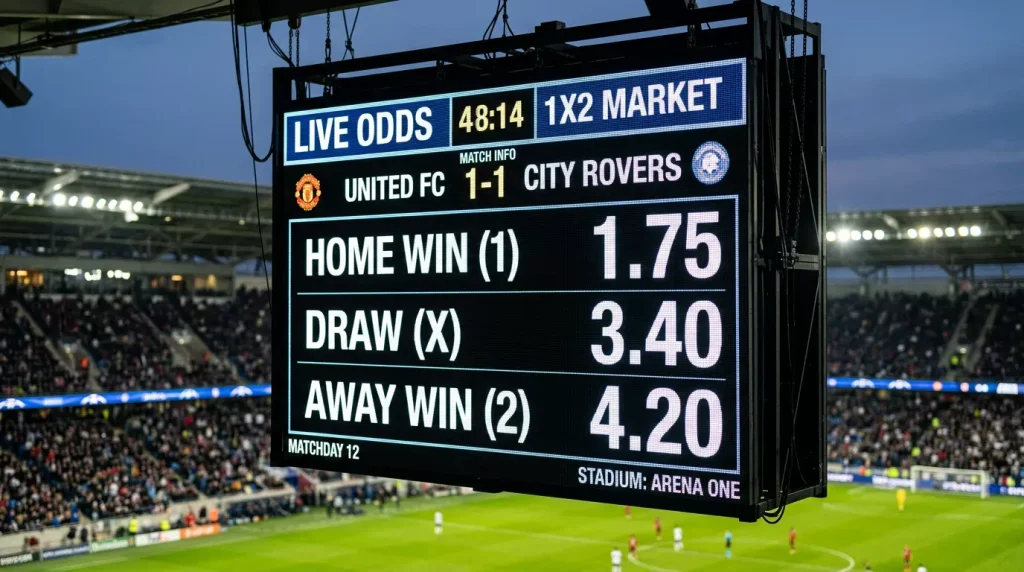
Canada plays Bosnia and Herzegovina on June 12, 2026 at BMO Field. The sportsbook shows three numbers: 1.65 for Canada, 3.80 for draw, 5.00 for Bosnia. You want to bet $50 on Canada to win. If they do, you collect $82.50 — your $50 stake multiplied by 1.65. That transaction captures the essence of moneyline betting in soccer, though the simplicity conceals layers of calculation that separate recreational bettors from those who profit consistently across tournament football.
Moneyline betting — sometimes called 1X2 betting in European markets — asks you to predict one of three outcomes in a soccer match: home win (1), draw (X), or away win (2). Unlike North American sports where ties are rare, soccer’s draw option fundamentally changes the mathematics. That third outcome creates opportunities for sharp bettors who understand how oddsmakers price all three possibilities simultaneously.
What Is Moneyline Betting?
A friend who had never bet on soccer called me before the 2022 World Cup final. He wanted to know why Argentina was priced at 2.10 to beat France despite France being ranked higher in many power ratings. The answer reveals what moneyline betting actually measures: probability as estimated by the collective betting market, adjusted for sportsbook margin.
Moneyline odds express the sportsbook’s assessment of each outcome’s likelihood. In decimal format used by most Canadian sportsbooks, the number shows your total return per dollar wagered — stake plus profit combined. Argentina at 2.10 means a $10 bet returns $21 total: your original $10 plus $11 profit. France at 3.60 means a $10 bet returns $36 total. The draw at 3.40 returns $34 on a $10 stake.
Converting odds to implied probability reveals what the market believes. Divide 1 by the decimal odds: Argentina’s 2.10 becomes 1/2.10 = 47.6% implied win probability. France’s 3.60 becomes 27.8%. The draw’s 3.40 becomes 29.4%. These three percentages sum to 104.8% — the extra 4.8% represents the sportsbook’s margin, their guaranteed profit regardless of outcome. That margin, called vigorish or juice, is how sportsbooks stay in business.
Why does this matter for your World Cup betting? Understanding implied probability helps identify value. If you believe Canada has a 65% chance to beat Bosnia — higher than the market’s implied 60.6% from odds of 1.65 — then betting Canada offers positive expected value. Over many such bets, correct probability assessments produce profit even when individual wagers lose.
The three-way nature of soccer moneyline creates pricing dynamics absent from two-way sports. When bookmakers adjust one outcome’s odds, they must adjust the others to maintain their margin. If sharp money arrives on the draw, shortening its odds from 3.80 to 3.40, the sportsbook lengthens home and away prices to compensate. This interdependence creates arbitrage opportunities when different sportsbooks disagree on how probability distributes across outcomes.
How Moneyline Works in Soccer
The stadium clock struck 90 minutes in Morocco versus Portugal at the 2022 World Cup quarterfinal. Morocco led 1-0, but six minutes of stoppage time remained. Anyone holding a Morocco moneyline ticket watched those final minutes with heart rates elevated — one Portuguese goal would void their winning position. When the whistle finally blew, moneyline bettors who backed Morocco at opening odds around 6.00 collected six times their stake. That match illustrates how moneyline betting resolves.
Moneyline bets settle based on the final result after regulation time. At World Cup 2026, group stage matches end after 90 minutes plus stoppage time. If the score is level, the match ends in a draw — anyone who bet the draw wins, while home and away backers lose. No extra time occurs in group matches, making draw outcomes more frequent than in knockout rounds.
Knockout rounds change the calculation. Matches tied after 90 minutes proceed to 30 minutes of extra time, then penalty shootouts if necessary. However, moneyline betting for knockout matches typically settles after 90 minutes regardless of what follows. If you bet Germany to beat Japan in a hypothetical Round of 32 match and the score stands 1-1 after regulation, your Germany bet loses even if Germany wins the subsequent penalty shootout. The shootout determines who advances; it does not affect the 90-minute result that moneyline bets reference.
Some sportsbooks offer alternative moneyline markets that include extra time. These “draw no bet” or “to advance” markets remove or modify the draw option. Draw no bet refunds your stake if the match ends level after 90 minutes. To advance pays based on which team reaches the next round regardless of how they achieve it. These variations address knockout football’s complexity, but standard moneyline remains the most liquid market for match betting.
Goals scored matter only for winning or drawing — moneyline does not care about margin. Canada defeating Bosnia 5-0 pays the same as Canada winning 1-0. This differs from spread betting where margin matters. Moneyline’s simplicity appeals to bettors who want to predict winners without forecasting specific scorelines.
Calculating Moneyline Payouts
I once watched a novice bettor place $100 on a heavy favourite priced at 1.15, expecting a “sure thing” that would pay handsomely. His face fell when I explained his maximum profit was $15 — a 15% return on a bet he considered almost certain. Understanding payout calculations prevents such disappointment and helps evaluate whether potential returns justify the risk.
Decimal odds make calculations straightforward. Multiply your stake by the odds to find your total return, then subtract your stake to isolate profit. A $50 bet at 2.40 odds returns $120 total ($50 × 2.40), meaning $70 profit ($120 – $50). This formula works regardless of odds magnitude.
Converting between American and decimal formats helps Canadian bettors who encounter both. For positive American odds, divide by 100 and add 1. American +240 becomes 240/100 + 1 = 3.40 decimal. For negative American odds, divide 100 by the absolute value and add 1. American -150 becomes 100/150 + 1 = 1.67 decimal. Most sportsbooks allow you to toggle display formats in settings, eliminating manual conversion.
Calculating implied probability from decimal odds uses the formula: 1 divided by decimal odds, multiplied by 100 for percentage. Odds of 2.50 imply 40% probability (1/2.50 = 0.40 = 40%). Odds of 1.80 imply 55.6% probability. Odds of 4.00 imply 25% probability. These percentages represent what you must believe about each outcome’s likelihood for the bet to offer value.
Evaluating value requires comparing your probability estimate to implied probability. If you believe Spain has a 70% chance to beat Saudi Arabia but the odds of 1.35 imply only 74.1% probability, the market already prices Spain higher than your estimate — no value exists on the Spain side. Conversely, if you believe the draw has 18% probability but odds of 6.50 imply only 15.4% probability, the draw represents potential value. This comparison drives profitable betting over time.
Stake sizing based on edge magnitude helps manage bankroll. A bet where your estimated probability exceeds implied probability by 10% might warrant larger stakes than a bet where the edge is 3%. The Kelly Criterion provides mathematical guidance, though most recreational bettors use simplified versions: larger stakes for higher-confidence edges, smaller stakes for marginal advantages.
World Cup 2026 Moneyline Examples
Group B’s opening match between Canada and Bosnia and Herzegovina provides a concrete example for analysis. Pre-tournament odds might show Canada at 1.65, draw at 3.80, Bosnia at 5.00. These numbers encode bookmaker assessments about a debutant nation facing a home team with star power but limited World Cup experience.
Breaking down Canada’s 1.65 odds: implied probability is 60.6%. A $100 bet returns $165 if Canada wins, meaning $65 profit. The pricing reflects home advantage at BMO Field, Canada’s superior FIFA ranking, and the individual quality of Davies and David. However, Bosnia’s playoff qualification victory over Iceland demonstrated resilience under pressure. Sharp bettors might argue 60.6% overstates Canada’s true win probability for their World Cup opener against motivated opponents.
The draw at 3.80 implies 26.3% probability. World Cup group stage matches end level roughly 25-30% of the time historically. This pricing appears fair, though nervous opening matches where both teams prioritize not losing can produce elevated draw frequencies. If you believe the opening-match psychology pushes draw probability toward 30%, these odds offer slight value.
Bosnia at 5.00 implies 20% win probability. Debutant nations have won opening matches before — Senegal beat France 1-0 in 2002, Japan defeated Germany in 2022. Bosnia’s odds price in heavy underdog status, but their qualification path included quality opponents. A $50 bet on Bosnia returns $250 if they produce an upset — a 400% profit that compensates for the higher probability of loss.
Consider a hypothetical Group D match: USA versus Türkiye. Pre-tournament odds might show USA at 1.85, draw at 3.50, Türkiye at 4.20. American home advantage justifies their favouritism, but Türkiye’s attacking talent creates upset potential. The draw at 3.50 (28.6% implied) reflects evenly matched teams where stalemates are plausible. Sharp bettors analyze how venue, travel, and tactical matchups affect these baseline probabilities.
Knockout round moneyline differs in character. A hypothetical quarterfinal between France and Germany might price France at 2.10, draw at 3.30, Germany at 3.50. Note how odds compress toward even money compared to group mismatches — the market expects knockout matches between survivors to be more competitive. The draw at 3.30 (30.3% implied) acknowledges that elite teams playing for elimination often produce cagey matches where neither side takes excessive risks.
For comprehensive coverage of all World Cup betting markets beyond moneyline, the complete betting guide addresses advanced strategies and alternative wager types.
Applying Moneyline Strategy at World Cup 2026
Theory becomes profit only through disciplined application. The World Cup 2026 schedule spans 39 days with 104 matches, creating abundant moneyline opportunities. Strategic frameworks help navigate this volume without impulsive betting that drains bankrolls.
Match selection matters more than match prediction. Not every game offers value; some lines are correctly priced. Profitable bettors skip matches where their analysis does not identify edge, focusing capital on opportunities where probability assessments diverge from market prices. Quality over quantity means betting 20 carefully selected matches rather than 80 random selections.
Group stage dynamics differ from knockout betting. Third-match group games often feature teams with different motivations — already-qualified sides may rotate lineups while desperate opponents field full-strength teams. These motivation mismatches create value opportunities the market sometimes misprices. A Brazil team already through might rest stars against Scotland, shifting fair odds away from pre-tournament assessments.
Draw frequency varies by match context. Opening group matches produce more draws as teams avoid early mistakes. Third group matches between eliminated teams see increased draws when neither has advancement incentive. Knockout rounds where advancing teams seek protection produce draws heading into extra time. Tracking these tendencies helps calibrate draw probability estimates.
Line movement provides information. If Canada opens at 1.80 against Qatar but moves to 1.60 by kickoff, sharp money likely supported Canada. Conversely, drift from 1.80 to 2.00 suggests money arriving on Qatar or the draw. Following line movement helps identify where informed bettors are positioning, though blindly following steam moves without independent analysis is not profitable long-term.
Bankroll allocation requires discipline. Reserve no more than 3-5% of your World Cup betting bankroll for any single moneyline wager. This sizing survives losing streaks that variance inevitably produces across 104-match tournaments. A $500 tournament bankroll means maximum $25 per bet, allowing 20+ wagers even if early selections lose.
Live betting extends moneyline opportunities mid-match. If Spain leads Saudi Arabia 1-0 at halftime, their live moneyline odds shorten dramatically from pre-match prices. Conversely, if underdogs take early leads, their odds present different value calculations. Live betting requires quick probability updates based on match flow, making it suitable for experienced bettors who can process information under time pressure.
Record keeping improves future betting. Track every moneyline wager including your pre-bet probability estimate, the implied probability from odds, and the result. Over the tournament, analyze where your estimates proved accurate versus where markets were correct. This feedback loop refines probability estimation skills for future betting.
World Cup moneyline betting rewards preparation, discipline, and emotional control. The tournament provides approximately 100 betting opportunities across six weeks. Selective, value-focused wagering transforms entertainment into a structured approach where long-term profit becomes possible for those willing to invest analytical effort.
