
BMO Field World Cup 2026: Toronto’s Tournament Venue
 Available in US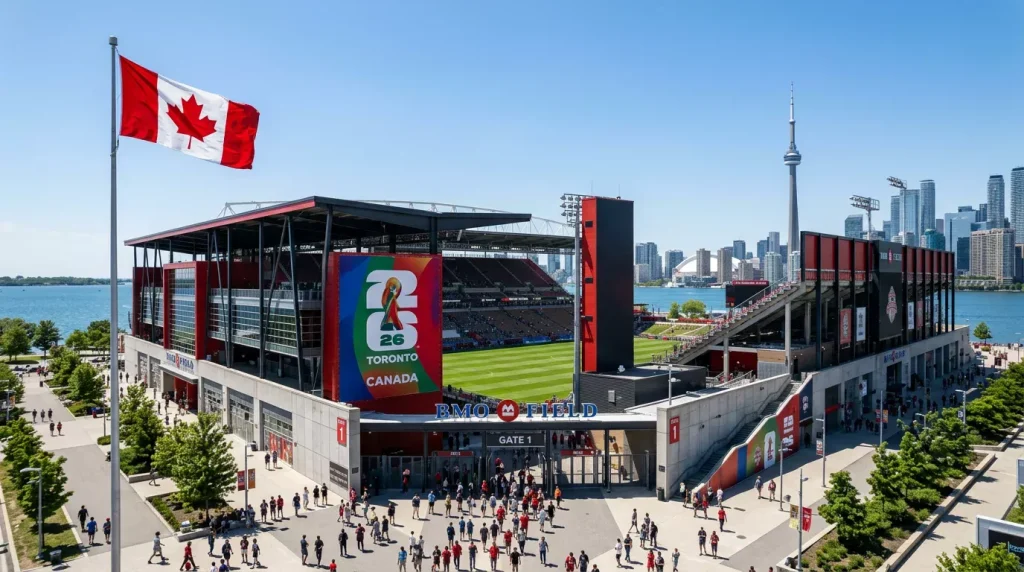
Exhibition Place, Toronto. A stadium purpose-built for soccer in a hockey-obsessed nation. When BMO Field hosts World Cup 2026 matches, decades of Canadian football development converge in a single tournament moment. I’ve attended matches at BMO Field since its 2007 opening — watching Toronto FC’s inaugural MLS season, Champions League qualifiers, and countless Canada national team fixtures. The venue’s transformation into a World Cup stage represents everything Canadian soccer supporters have worked toward since well before my career began covering international tournaments.
BMO Field at World Cup 2026 carries significance beyond mere venue selection. Toronto’s stadium hosts Canada’s opening match against Bosnia and Herzegovina on June 12, 2026 — the CanMNT’s first World Cup home fixture in program history. The betting implications of this venue choice matter enormously: home advantage at BMO Field creates quantifiable uplift for Canadian result probabilities that informed bettors must incorporate into their analysis.
BMO Field: Stadium Profile
The stadium rose from Exhibition Place grounds in 2007 as Canada’s first soccer-specific venue designed to FIFA standards. Toronto FC’s arrival in MLS coincided with the facility’s opening, creating immediate connection between professional club football and the broader Canadian soccer community. Sixteen years of institutional development, infrastructure improvements, and capacity expansions prepared BMO Field for this moment.
Location within Toronto’s urban fabric provides exceptional accessibility compared to suburban stadium alternatives common across North America. Exhibition Place sits along Lake Ontario’s waterfront, connected to downtown Toronto via streetcar lines, the GO Transit rail network, and major highway arteries. International visitors arriving through Toronto Pearson Airport face manageable transit options reaching the venue. The proximity to downtown accommodation concentrations simplifies tournament logistics for both participating teams and travelling supporters.
The original 2007 configuration seated approximately 20,000 spectators in an intimate, soccer-focused design. Subsequent expansions — particularly the 2015-2016 renovation adding roofed seating sections — increased permanent capacity toward 30,000. For World Cup 2026, temporary structures will further expand capacity to meet FIFA’s venue requirements, though final tournament configuration numbers remain subject to official confirmation as event planning progresses.
Pitch dimensions meet FIFA international standards, with the natural grass surface receiving enhanced maintenance protocols ahead of tournament fixtures. The grass playing surface distinguishes BMO Field from artificial turf venues that have drawn criticism from players and managers at previous tournaments. Canada’s national team trains regularly on BMO Field’s surface, creating familiarity advantages that artificial turf venues cannot provide.
World Cup 2026 Matches at BMO Field
FIFA venue allocation assigns BMO Field a portion of the 13 Canadian matches across the tournament’s group stage and early knockout rounds. The exact fixture list depends on FIFA’s scheduling confirmations, but structural parameters clarify what Toronto supporters can expect.
Canada versus Bosnia and Herzegovina on June 12, 2026, represents BMO Field’s headline fixture — the CanMNT’s World Cup home opener that Canadian supporters have awaited for generations. The afternoon kickoff at 3:00 PM Eastern places the match during prime viewing hours across Canadian time zones while accommodating European broadcast schedules. This single fixture carries more emotional weight than any previous match hosted at the venue.
Additional group stage fixtures will bring international teams to Toronto, though specific matchups depend on broadcast scheduling and FIFA venue assignments. BMO Field’s capacity limitations compared to larger American venues may affect allocation of higher-profile fixtures, potentially concentrating less commercially prominent matches in Toronto while reserving MetLife Stadium or SoFi Stadium for blockbuster encounters.
Round of 32 matches represent the deepest knockout round stage likely assigned to BMO Field given capacity constraints. Quarter-final or later fixtures typically require venues exceeding 60,000 capacity to maximize ticket revenue and broadcast atmosphere — BMO Field’s expanded configuration falls short of those thresholds.
Canada’s Historic Home Opener
June 12, 2026, at BMO Field marks a date that Canadian soccer supporters have imagined for decades. The CanMNT has never played a World Cup match on home soil — every previous tournament appearance required international travel to host nations. This fixture against Bosnia and Herzegovina reverses that dynamic entirely, placing Canada in the familiar confines of their primary home venue against opponents managing jet lag, unfamiliar conditions, and hostile crowd environments.
The psychological significance extends beyond simple home advantage calculations. Alphonso Davies, Jonathan David, and the Canadian squad will walk onto a pitch they’ve played on dozens of times, surrounded by supporters who’ve watched their journey from Qatar 2022 qualification through CONCACAF Nations League success to this tournament moment. That emotional foundation creates intangible advantages that statistical models struggle to capture but experienced tournament analysts recognize as meaningful.
Bosnia and Herzegovina arrive as tournament debutants, their first-ever World Cup match taking place under circumstances maximally hostile to their aspirations. The Bosnian squad must cope with transatlantic travel, time zone adjustment, and an atmosphere designed to intimidate visiting teams. Every BMO Field design element — from steep seating angles to proximity of supporters to the touchline — amplifies home advantage effects.
My assessment incorporates approximately 8-12% additional win probability for Canada at BMO Field compared to neutral venue projections. This figure derives from historical analysis of home advantage effects at major tournaments, adjusted for Canada’s specific familiarity with the venue and Bosnia’s complete absence of World Cup experience. The betting implications are substantial: markets that fail to adequately price Canadian home advantage create value opportunities for informed bettors.
Capacity and World Cup Expansion
FIFA venue requirements establish minimum capacity thresholds that permanent BMO Field configurations don’t quite meet. The gap between standing capacity and tournament requirements necessitates temporary expansion measures that will transform the stadium’s footprint during World Cup 2026.
Permanent seating configurations provide approximately 28,000-30,000 capacity depending on configuration requirements. The roofed sections added during 2015-2016 renovations improved weather protection and atmosphere density while incrementally increasing total seats. These permanent structures form the foundation for tournament configuration.
Temporary expansion through additional seating structures will push World Cup capacity toward 40,000-45,000 range, though exact figures await official FIFA and tournament organizing committee confirmation. Temporary structures typically occupy areas adjacent to permanent seating, potentially extending into Exhibition Place grounds surrounding the stadium footprint. The technical challenge involves maintaining sightlines and atmosphere quality while significantly expanding spectator capacity.
Post-tournament legacy considerations shape expansion planning. Temporary structures will be removed following World Cup 2026, returning BMO Field to permanent configurations appropriate for Toronto FC’s ongoing MLS operations. The tournament serves as temporary capacity peak rather than permanent expansion trigger, though infrastructure improvements made in preparation for the event provide lasting benefits.
Location and Getting There
Exhibition Place’s position along Toronto’s waterfront creates multiple transit pathways for spectators accessing BMO Field during World Cup 2026. Understanding arrival logistics helps both local supporters and international visitors plan tournament match attendance effectively.
The TTC’s 509 Harbourfront and 510 Spadina streetcar lines provide direct connections from downtown Toronto to Exhibition Place, with stops immediately adjacent to the venue grounds. Match days will see enhanced streetcar frequency and additional service capacity, though crowding should be expected during peak arrival and departure windows. Presto fare payment systems require advance card acquisition for international visitors unfamiliar with Toronto transit infrastructure.
GO Transit’s Exhibition station provides regional rail access from suburban Toronto areas and connecting communities throughout the Greater Toronto Area. Match day service schedules typically include additional departures following fixture conclusions, reducing post-match crowding compared to regular service patterns. Visitors from Hamilton, Burlington, Oakville, or Mississauga find GO Transit particularly convenient given downtown parking challenges.
Vehicle arrival creates parking challenges that public transit alternatives largely avoid. Exhibition Place parking lots serve BMO Field events, though capacity limitations relative to expanded World Cup attendance suggest arriving exceptionally early if driving remains necessary. Rideshare services face similar demand surges that extend wait times and increase pricing during arrival and departure windows.
Union Station serves as Toronto’s central transit hub, connecting the airport via the UP Express, downtown hotels via subway lines, and Exhibition Place via streetcar transfers. International visitors flying into Pearson Airport should route through Union Station for most efficient venue access rather than attempting direct airport-to-venue transit that requires complicated transfer sequences.
Betting Implications: Home Field Factor
Every analytical framework I’ve developed for tournament betting incorporates venue-specific factors that influence match probabilities. BMO Field’s characteristics create distinct advantages for Canada that affect both outright result markets and various proposition bets.
Crowd density and proximity to the pitch at BMO Field generates intimidation effects that larger, more distant stadium configurations cannot replicate. Opposing players warming up along touchlines hear every chant directly. The compact bowl design amplifies sound in ways that cavernous 80,000-seat venues dissipate. For Bosnia and Herzegovina’s World Cup debutants, this environment will feel overwhelming compared to even the most hostile European club fixtures they’ve experienced.
Climate conditions in mid-June Toronto typically feature temperatures in the 20-25°C range (70s Fahrenheit) with moderate humidity — comfortable conditions for athletic performance without heat stress concerns that affect Southern US venues. European teams generally find these conditions comparable to home environments, while Central American, African, or Middle Eastern opponents face neither advantage nor disadvantage. The climate neutrality allows tactical and technical factors to determine outcomes rather than physical conditioning disparities.
Pitch familiarity matters more than casual observers recognize. Canada’s national team trains at BMO Field regularly, understanding precise dimensions, turf speed, and surface characteristics that opponents must adapt to in real-time during matches. This familiarity translates into confidence during ball control situations, accurate passing weight calculations, and defensive positioning calibrated to specific pitch dimensions.
My betting approach for Canada’s BMO Field fixtures incorporates these factors through adjusted probability models that increase Canadian win likelihood by 8-12% compared to neutral venue baselines. For the Bosnia and Herzegovina opener specifically, this adjustment pushes Canada into heavy favourite territory regardless of raw squad quality comparisons. Value exists if betting markets underweight home advantage effects relative to my assessment.
Toronto’s role as one of two Canadian World Cup venues makes BMO Field essential to understanding the complete stadium landscape across North America. The betting implications extend beyond single matches — Canada’s home advantage concentration in Toronto and Vancouver shapes their entire group stage probability structure.
