
All 48 Teams at World Cup 2026: Profiles, Odds and Analysis
 Available in US
Five nations enter the 2026 World Cup for the first time in their history. Curaçao’s population barely exceeds 150,000 — smaller than some European club stadiums. Argentina defends the trophy Lionel Messi lifted in Qatar. Forty-eight stories converge across North America between June 11 and July 19, 2026. Having followed World Cup qualifying across six confederations for nine years, I’ve assembled this comprehensive guide to every team contesting the expanded tournament. Understanding who these nations are, how they reached this stage, and what betting markets expect from them creates the foundation for informed World Cup analysis.
48 Teams by the Numbers
The expanded World Cup field reveals striking contrasts. Argentina (FIFA ranking #1) faces Jordan (FIFA #71) in Group J — a 70-position gap representing different football universes. The average FIFA ranking across all 48 teams sits around 38, though that average obscures wild variance. The top 10 ranked nations all qualified; so did 5 teams making their tournament debuts. Past champions account for 9 of 48 spots: Brazil (5 titles), Germany (4), Argentina (3), France (2), Uruguay (2), England (1), Spain (1), Italy did not qualify, same with former champions who no longer exist as unified nations.
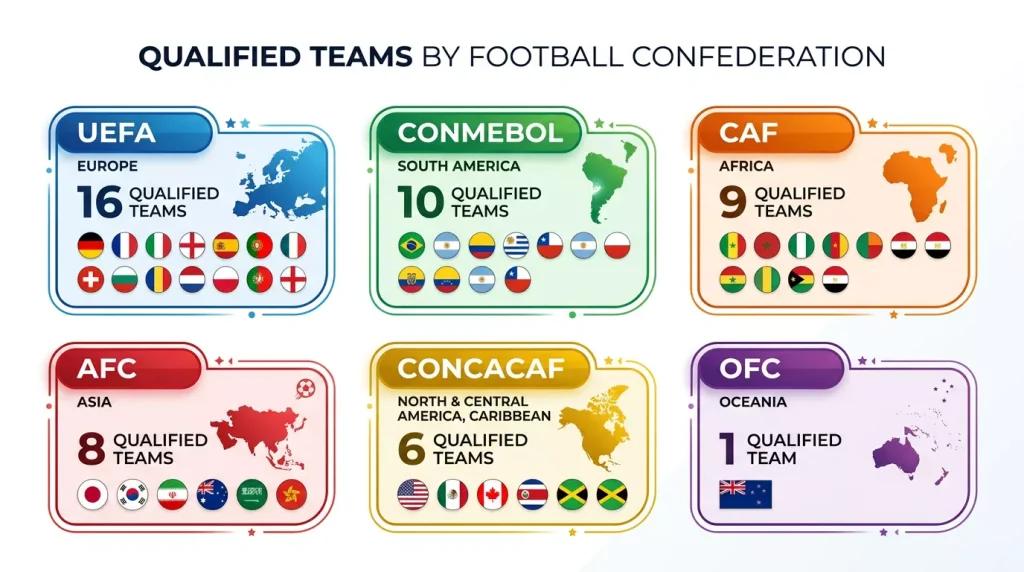
Geographic distribution reflects confederation berths. UEFA contributes 16 teams — one-third of the field. CONMEBOL sends all 10 member nations for the first time since qualification format changes. CONCACAF’s 6 spots include all three co-hosts plus Jamaica, Haiti, and Panama. CAF’s 9 African representatives enter with Morocco’s 2022 semifinal fresh in memory. AFC sends 8 Asian teams plus Australia (technically AFC since 2006). OFC finally earns an automatic berth with New Zealand.
Betting market concentration tells its own story. The top 5 favourites (Spain, France, England, Argentina, Brazil) account for approximately 65% of implied championship probability. The remaining 43 teams share 35% of implied probability. For bettors, this concentration suggests outright long shots carry high variance — but group stage and match-specific markets on mid-tier teams offer exploitable value where bookmaker attention decreases.
Squad age profiles vary dramatically. Spain’s young core averages approximately 25 years old; Croatia’s midfield foundation (Modrić, Brozović, Kovačić) all exceed 30. Tournament success historically correlates with squads balancing experienced leaders and peak-age performers, not youth alone. Germany’s young 2014 champions had Philipp Lahm, Per Mertesacker, and Miroslav Klose providing veteran presence. Pure youth struggles under tournament pressure.
Host Nations: USA, Mexico and Canada
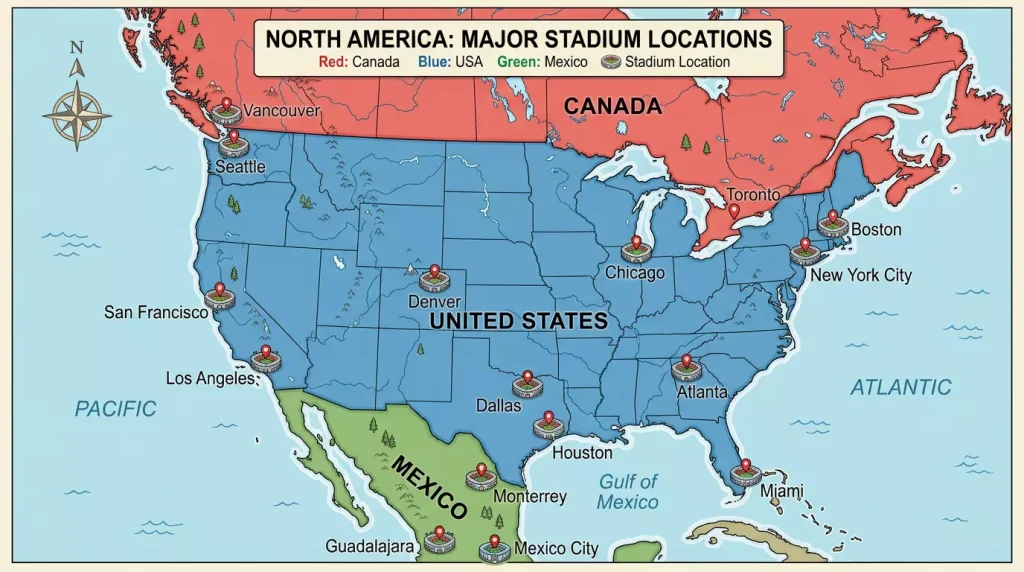
Watching the co-hosting announcement in 2018, I remember wondering how three nations spanning 8 time zones would share football’s biggest prize. Eight years later, the logistics are settled: USA hosts 78 matches at 11 venues, Mexico hosts 13 matches at 3 venues, and Canada hosts 13 matches at 2 venues. Each host nation carries home-field advantages that betting markets must price — with varying degrees of accuracy.
United States: Largest Host Presence
The USMNT enters their home World Cup with genuine talent and intense domestic pressure. Christian Pulisic leads a generation that includes Weston McKennie, Tyler Adams, Giovanni Reyna, and goalkeeper Matt Turner. Their 2022 World Cup showed competitive spirit (a credible draw against England, defeat to Netherlands in the Round of 16) without suggesting championship calibre.
Home advantage manifests across 11 venues spanning Seattle to Miami. Group D matches against Australia, Paraguay, and Türkiye at American venues create favourable conditions. Betting markets price USA at approximately 15.00 for the tournament — shorter odds than pure on-pitch ability suggests, reflecting host premium. The gap between public expectation and actual squad quality creates potential fade opportunities when USA meets elite opposition in knockout rounds.
Key players: Pulisic’s creativity drives the attack; Adams’ midfield control sets tempo; young talents like Folarin Balogun (if he maintains eligibility) add options. The question is whether American development programmes have produced enough depth to survive a tournament requiring six knockout wins.
Mexico: Third-Time Hosts Seeking Breakthrough
El Tri enters 2026 desperate to break “la maldición del quinto partido” — the curse of the fifth game that has seen Mexico eliminated in the Round of 16 at seven consecutive World Cups. Home soil at Estadio Azteca (Mexico City), Estadio BBVA (Monterrey), and Estadio Akron (Guadalajara) creates genuine advantage, especially at altitude in Mexico City where visiting teams struggle physiologically.
The squad transitions between generations. Veterans like Guillermo Ochoa provide experience; younger talents must emerge to replace aging pillars. Group A opponents (South Korea, South Africa, Czechia) appear manageable without guaranteeing progression. At approximately 67.00 for the tournament, Mexico offers long-shot value if you believe home support enables overperformance beyond their FIFA ranking suggests.
Canada: Historic Home Opportunity
Canada qualified for Qatar 2022 after a 36-year World Cup absence — and immediately returns for a home tournament. The emotional significance cannot be overstated: this generation of Canadian players, led by Alphonso Davies, writes football history with every match at BMO Field and BC Place.
Davies alone represents world-class quality, his pace and attacking ability from left-back creating constant threat. Jonathan David’s goal-scoring consistency at Lille translates to international optimism. The squad lacks depth compared to elite nations, but Group B opponents (Switzerland, Qatar, Bosnia and Herzegovina) present beatable challenges. Canada’s complete profile details their path through Group B and realistic tournament ceiling. At 51.00 for the tournament and 2.60 to win their group, Canada offers value plays for bettors who believe home advantage and favourable draw align.
Tournament Favourites: Odds Under 10.00
The five shortest-priced teams share common traits: established tournament pedigree, world-class individuals across positions, and tactical systems refined over years rather than assembled hastily for qualification. What separates these favourites from contenders? Consistency. They reach knockout rounds reliably; their variance narrows as tournament pressure increases.
Spain (6.00)
Euro 2024 champions with the youngest squad to win a major international tournament in decades. Lamine Yamal became the tournament’s breakout star at 17; Pedri and Gavi control midfield tempo; Rodri anchors from deep. Spain’s possession-based identity survived coaching transitions and now produces results rather than frustrated dominance. Their 4-3-3 creates numerical superiority in midfield, suffocating opponents’ transition opportunities.
Group H (Uruguay, Saudi Arabia, Cape Verde) offers straightforward progression. The knockout path determines whether Spain converts favourite status into the trophy — historically their challenge since 2010. Current squad depth exceeds any Spanish team I’ve analysed, suggesting the market prices them accurately rather than overvalues their Euro success.
France (6.50)
Back-to-back World Cup finalists, 2018 champions and 2022 runners-up. France’s tournament DNA runs deep — this generation knows how to win. Kylian Mbappé enters his prime tournament years at 27, surrounded by Antoine Griezmann’s experience and emerging midfield talents.
Complacency concerns surface periodically. France underperformed at Euro 2020 (Round of 16 exit) and Euro 2024 (semifinals). World Cups seem to activate their competitive focus differently. Group I (Senegal, Iraq, Norway) provides adequate challenge without serious upset risk. Mbappé’s form and fitness entering the tournament will determine whether France converts talent into a third title since 1998.
England (7.00)
The Golden Generation 2.0 — except this time the label might be accurate. England’s squad depth rivals any nation: multiple world-class options at every position, competition for starting spots that raises training standards, and enough experience from Euro finals (2021, 2024) to handle pressure moments.
The persistent question: can England actually win? Semi-finals and finals without trophies define their recent tournament history. Group L reunites them with 2018 World Cup semifinal foes Croatia, plus Ghana and Panama. On paper, England should progress comfortably. On paper, England always should. Whether 2026 breaks the trophy drought or continues the pattern determines massive betting implications.
Argentina (8.00)
Defending champions with Lionel Messi’s participation creating the tournament’s biggest storyline. At 39, Messi cannot replicate 2022 physical contributions — but his presence, even in reduced minutes, affects teammates and opponents psychologically. Argentina’s supporting cast (Julián Álvarez, Enzo Fernández, Alexis Mac Allister) matured into legitimate stars since Qatar.
No nation has defended the World Cup since Brazil in 1962. That historical pattern combines with natural squad aging to create Argentine vulnerability that their 8.00 price somewhat reflects. Group J (Algeria, Austria, Jordan) appears comfortable; the question is whether Argentina can replicate knockout round magic without prime Messi.
Brazil (9.00)
Five-time champions with a drought extending to 2002. Vinícius Jr. leads an attacking generation that thrills domestically without translating to international tournament success. Their 2022 quarterfinal exit to Croatia (penalties, 1-1 after extra time) continued a frustrating pattern of disappointment despite clear talent advantages.
Group C (Morocco, Haiti, Scotland) requires dispatching 2022 semifinalists Morocco to confirm group control. Brazil’s attacking identity generates entertainment but defensive vulnerability — their 2022 exit came through failing to close out a winning position. At 9.00, Brazil offers value if you believe their young core has matured; fade value if you expect continued big-stage underperformance.
Dark Horses and Contenders
The tier between favourites (under 10.00) and long shots (over 50.00) contains the most interesting betting value. These teams possess genuine quality, experienced tournament performers, and tactical identities capable of beating anyone on their day. What they lack is the consistent excellence that separates them from the elite.
Germany (12.00)
Two consecutive group stage exits (2018, 2022) destroyed confidence in a nation that won four World Cups. Julian Nagelsmann’s appointment and home Euro 2024 restored some optimism before Spain ended their quarterfinal hopes. The squad rebuilds with Jamal Musiala, Florian Wirtz, and Kai Havertz leading the attacking transition. Defensive solidity remains questionable — neither Antonio Rüdiger’s quality nor Marc-André ter Stegen’s saves compensated for structural vulnerabilities.
Group E (Ecuador, Ivory Coast, Curaçao) should see Germany progress, but “should” has failed twice consecutively. At 12.00, Germany offers value if redemption narratives drive their performance; fade opportunities exist if the 2018-2022 pattern reflects deeper decline rather than temporary stumbles.
Netherlands (13.00)
Total football’s heirs without a World Cup trophy despite three finals appearances. Their attacking style thrills viewers while terrifying Dutch supporters who’ve watched tournament exits compound across decades. Current squad features Cody Gakpo, Memphis Depay’s experience, and Virgil van Dijk’s defensive leadership.
Group F (Japan, Sweden, Tunisia) contains upset potential — Japan’s organized pressing troubled Germany and Spain in 2022. Netherlands likely advances but potentially not as group winners if Japan replicates their Qatar form. At 13.00, the Dutch represent genuine contender value if their attack clicks; frustrating fade material if defensive lapses continue.
Portugal (14.00)
Cristiano Ronaldo’s presence at 41 dominates discussion about Portugal’s prospects. Whether he remains an asset (leadership, goal-scoring instinct) or becomes a liability (declining mobility, tactical limitation) divides analyst opinion sharply. The post-Ronaldo transition awaits; Portugal’s younger talents (Rafael Leão, João Félix) must eventually carry the squad.
Group K pairs Portugal with Colombia in the tournament’s most competitive top-two battle. Both teams possess attacking quality; head-to-head may determine group winner. Portugal’s 14.00 price reflects talent while acknowledging uncertainty around Ronaldo’s role and knockout round conversion challenges.
Other Contenders Worth Monitoring
Belgium (17.00) enters the tournament with their golden generation’s window closing rapidly. Kevin De Bruyne and Romelu Lukaku remain world-class when fit; the question is whether supporting quality has diminished too far since their 2018 third-place finish. Group G (Iran, Egypt, New Zealand) offers comfortable progression without testing their ceiling. Belgium’s value lies in fade opportunities when they face elite opposition rather than backing their increasingly uncertain quality.
Croatia (26.00) continues defying expectations through midfield excellence that compensates for overall squad limitations. Luka Modrić at 40 years old cannot sustain tournaments physically, yet his influence on teammates and opponents transcends individual contribution. Group L pairs them with England — their 2018 semifinal conquerors — creating a marquee group stage clash. Croatia represents genuine dark horse value if their experienced core delivers one final deep run.
Denmark (35.00) applies tactical organization that produces competitive performances against superior opponents. Their Euro 2021 run (semifinals despite Christian Eriksen’s collapse) and 2022 World Cup showed system over stars approach. Rasmus Højlund’s emergence adds attacking dynamism that previous Danish squads lacked. Morocco (41.00) must prove their 2022 semifinal represented sustainable quality rather than circumstantial magic. Japan (45.00) caused both Germany and Spain group stage losses in 2022 — dismissing them as long shots ignores concrete evidence of competitive capability against elite opposition.
First-Time Participants: 5 Debutants
Watching Curaçao qualify for their first World Cup felt like witnessing history that transcends sport. An island of 150,000 people competing against nations with populations 100 times larger. These five debutants — Curaçao, Cape Verde, Uzbekistan, Jordan, and Bosnia and Herzegovina — represent the expanded World Cup’s democratic promise: more nations experiencing football’s greatest stage.
Curaçao (Group E — Germany, Ecuador, Ivory Coast)
The Caribbean island nation’s population could fit inside Dortmund’s Signal Iduna Park with seats to spare. Their qualification came through CONCACAF’s expanded pathway, overcoming traditional CONCACAF powers to claim a spot. Realism suggests three group stage losses — Germany, Ecuador, and Ivory Coast all possess superior quality. Romanticism hopes for a historic draw or moment that justifies their presence. At 501.00 for the tournament, Curaçao represents entertainment betting rather than serious investment.
Cape Verde (Group H — Spain, Uruguay, Saudi Arabia)
The African island nation faces the daunting task of troubling Spain and Uruguay in Group H. Their compact, organized defensive approach might limit damage without generating results. Saudi Arabia presents the best opportunity for points — both debutant-level nations seeking to avoid bottom position. Cape Verde’s 501.00 odds reflect minimal realistic advancement chances.
Uzbekistan (Group K — Portugal, Colombia, DR Congo)
Central Asian qualification rewarded years of competitive performances. Group K’s construction — Portugal, Colombia, Uzbekistan, DR Congo — creates genuine possibility for Uzbekistan to claim third place and potentially advance as one of eight best third-place finishers. Their defensive organization and counter-attacking threat makes them more than tourist participants. At 301.00, Uzbekistan offers outside value if their group unfolds favourably.
Jordan (Group J — Argentina, Algeria, Austria)
Middle Eastern representation expands with Jordan’s debut. Group J contains defending champions Argentina and competitive Austria and Algeria. Jordan’s realistic ceiling is fourth place; third place would represent significant overperformance. Their 401.00 odds appropriately price minimal tournament impact expectations.
Bosnia and Herzegovina (Group B — Canada, Switzerland, Qatar)
Technically their first World Cup as an independent nation of this era (Yugoslavia’s history complicates the record). Group B offers beatable opponents: Canada lacks tournament experience, Qatar disappointed as 2022 hosts, and Switzerland represents the clear challenge. Bosnia’s passionate supporter base and technically skilled squad could compete for third place. At 201.00, they represent the most realistic debutant dark horse for knockout round advancement.
Teams by Confederation Breakdown
The six confederations send varying proportions of their member nations, creating qualification stories that range from automatic host berths to multi-year campaigns across hundreds of matches. Understanding each confederation’s pathway contextualizes squad quality and tournament readiness.
UEFA (Europe — 16 Teams)
Spain, France, England, Germany, Netherlands, Portugal, Belgium, Croatia, Denmark, Switzerland, Austria, Serbia, Scotland, Sweden, Norway, Czechia. European qualification combines group stage with playoffs, producing 16 of 55 member nations. The depth ensures competitive quality across all UEFA qualifiers — no truly weak European team reaches World Cups given the elimination pathway.
Notable absences: Italy failed to qualify despite being reigning European champions in 2021, continuing their 2018 World Cup miss. Poland and Wales fell short through playoffs. Ukraine’s qualification campaign occurred during wartime displacement, making their absence understandable if disappointing.
CONMEBOL (South America — 10 Teams)
Argentina, Brazil, Uruguay, Colombia, Ecuador, Paraguay, Bolivia, Chile, Peru, Venezuela. All 10 CONMEBOL member nations qualify under the expanded format — an unprecedented situation that eliminates traditional South American qualification drama. The round-robin qualifying campaign remains brutal (18 matches against every other nation), but automatic qualification for all produces different competitive dynamics.
This completeness means varying quality levels. Argentina, Brazil, Uruguay, and Colombia represent genuine tournament competitors. Ecuador showed 2022 improvement. Paraguay and Chile declined from previous peaks. Bolivia, Peru, and Venezuela enter as likely group stage departures with occasional upset capability.
CONCACAF (North/Central America and Caribbean — 6 Teams)
USA, Mexico, Canada, Jamaica, Haiti, Panama. The three co-hosts received automatic berths; the remaining three spots went to qualification winners. CONCACAF’s quality drops sharply beyond the top tier — Jamaica, Haiti, and Panama face uphill battles in group stages without realistic advancement expectations.
Haiti’s qualification represents particular achievement given ongoing national challenges. Their participation means more than results — representing hope and resilience for a nation rarely featured on global sporting stages.
CAF (Africa — 9 Teams)
Morocco, Senegal, Ivory Coast, Egypt, Algeria, Ghana, South Africa, Tunisia, DR Congo. Morocco’s 2022 semifinal proved African teams can compete at the highest levels. Senegal reached Round of 16 the same tournament. Ivory Coast claimed the 2024 Africa Cup of Nations. African football quality continues ascending.
The nine representatives include continental champions (Ivory Coast), proven World Cup competitors (Morocco, Senegal, Ghana), and nations seeking breakthrough moments (DR Congo, Tunisia). African group stage performance will indicate whether 2022 represented African football’s arrival or a single tournament anomaly.
AFC (Asia — 8 Teams + Australia)
Japan, South Korea, Saudi Arabia, Iran, Qatar, Uzbekistan, Jordan, Iraq, plus Australia (AFC member since 2006). Asian qualification pathways produced competitive teams — Japan and South Korea have historically troubled European opposition in World Cups. Saudi Arabia’s 2022 victory over Argentina remains the tournament’s defining upset, proving Asian teams can compete against elite opposition when circumstances align.
Qatar’s automatic qualification as 2022 hosts didn’t prepare them for actual competition; their zero-point, one-goal group stage raised questions about hosting bid benefits. They must prove competitiveness in 2026 without home advantage. Iran brings organized defensive structure that frustrates opponents; their 2022 performance against USA showed competitive quality beyond their ranking suggests. Australia’s AFC membership since 2006 simplified their qualification pathway compared to OFC playoff requirements — they enter as genuine dark horses capable of group stage advancement in favourable circumstances.
The Asian confederation’s tactical evolution deserves recognition. Japanese players now staff major European clubs; South Korean players compete at Premier League level regularly. This quality elevation translates to national team performances that no longer represent easy group stage points for European opposition.
OFC (Oceania — 1 Team)
New Zealand finally receives an automatic berth under the expanded format. Previous World Cup appearances came through inter-confederation playoffs that OFC teams rarely won. Their 2010 group stage included three draws against Slovakia, Italy, and Paraguay — competitive without winning, demonstrating organized defensive capability that limited superior opponents.
The All Whites enter as heavy underdogs in Group G (Belgium, Iran, Egypt) but their guaranteed qualification represents significant progress for Oceanian football development. For decades, OFC nations competed knowing a single playoff match against superior opposition stood between them and World Cup qualification. The expanded format removes that barrier, ensuring Oceanian representation regardless of playoff luck. New Zealand’s 2026 participation matters beyond their results — it validates structural changes that benefit smaller confederations.
Complete Odds Table: All 48 Teams
Compiling odds across multiple sportsbooks reveals market consensus while highlighting where operator opinions diverge. The following table represents approximate median odds from major Canadian-accessible operators as of early 2026. These numbers will shift as the tournament approaches — tracking movements identifies value opportunities.
Championship Favourites (Under 15.00)
Spain 6.00 — France 6.50 — England 7.00 — Argentina 8.00 — Brazil 9.00 — Germany 12.00 — Netherlands 13.00 — Portugal 14.00
Contenders (15.00-30.00)
USA 15.00 — Belgium 17.00 — Italy did not qualify — Denmark 26.00 — Croatia 26.00 — Colombia 29.00
Dark Horses (31.00-60.00)
Uruguay 34.00 — Switzerland 41.00 — Morocco 41.00 — Japan 45.00 — South Korea 51.00 — Canada 51.00 — Senegal 51.00 — Türkiye 51.00 — Austria 67.00 — Mexico 67.00 — Serbia 67.00
Outside Chances (61.00-150.00)
Sweden 81.00 — Poland did not qualify — Ecuador 81.00 — Ivory Coast 81.00 — Norway 81.00 — Iran 101.00 — Egypt 101.00 — Algeria 101.00 — Scotland 126.00 — Ghana 126.00 — Australia 126.00 — Tunisia 126.00 — Paraguay 126.00 — Chile 151.00 — Peru 151.00
Long Shots (151.00-250.00)
Saudi Arabia 151.00 — Panama 176.00 — Qatar 176.00 — Jamaica 201.00 — Iraq 201.00 — Bosnia and Herzegovina 201.00 — DR Congo 201.00 — South Africa 201.00 — Czechia 201.00 — Bolivia 251.00 — Venezuela 251.00
Extreme Long Shots (251.00+)
Uzbekistan 301.00 — Jordan 401.00 — Haiti 401.00 — New Zealand 401.00 — Curaçao 501.00 — Cape Verde 501.00
These odds represent pre-tournament markets. Group stage results will dramatically adjust knockout round expectations. A favourite struggling in group matches sees their odds drift; an underdog winning their group sees odds shorten dramatically. The 48-team format creates more market movement opportunities than 32-team tournaments — monitor multiple operators to capture value across the shifting landscape.
Understanding odds tiers enables strategic betting. The favourite cluster (Spain through Portugal) offers limited value unless you identify specific market inefficiencies. The contender tier (USA through Senegal) contains exploitable positions where public attention decreases. Long shots from Uzbekistan through Curaçao represent entertainment wagers — small stakes for large potential returns with minimal realistic expectation. Canada’s position at 51.00 places them precisely at the dark horse threshold, offering genuine value if home advantage and favourable group construction align.
Pre-tournament odds also inform group stage and individual match betting. Teams priced as extreme long shots for the tournament often receive inflated match odds against shorter-priced opposition — creating value when backing underdogs in specific fixtures rather than tournament outrights. The 48-team structure produces more mismatches and more upset opportunities than concentrated 32-team fields.
The Field Assembled
Forty-eight nations representing every inhabited continent converge for football’s quadrennial celebration. From Spain’s Euro champions to Curaçao’s 150,000-person island; from Messi’s potential farewell to debutants writing their first World Cup chapter. The expanded field creates unprecedented storyline density across 39 days of competition.
For bettors, understanding this complete field enables informed decision-making beyond headline favourites. The contender tier from Germany through Morocco contains exploitable value where bookmaker attention decreases compared to elite nations. Debutants offer entertainment wagers with minimal serious expectation — the joy comes from participation rather than results. Host nations carry premiums worth monitoring for fade opportunities when they face elite knockout opposition. The confederation breakdown reveals which teams arrived through grueling qualification campaigns and which benefited from format expansion or automatic berths.
Group dynamics matter more in 48-team formats than previous iterations. Third-place finishers from 8 of 12 groups advance, creating qualification possibilities that didn’t exist when only group winners and runners-up progressed. This structural change rewards consistent performance over single match heroics — a team can lose once and still advance comfortably. For betting purposes, this reduces variance in group stage outcomes while increasing value opportunities on teams positioned for third-place advancement rather than outright group victory.
Canada’s position within this 48-team tapestry deserves particular attention for local bettors. Group B presents winnable matches; home venues create genuine advantage that visiting opponents from Switzerland, Qatar, and Bosnia will feel; and the supporting cast around Davies and David has improved since their 2022 appearance. Whatever your betting approach — following favourites, backing value dark horses, or placing patriotic stakes on the home nation — knowing all 48 teams transforms World Cup 2026 from spectacle into opportunity.
