
MetLife Stadium World Cup 2026: The Final Venue
 Available in US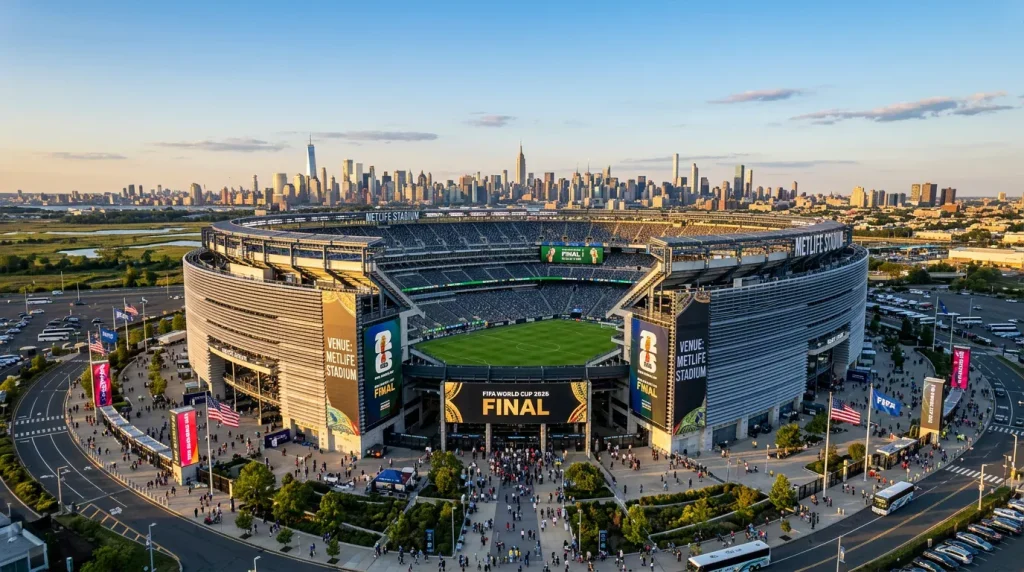
On July 19, 2026, the biggest single sporting event on the planet will take place in East Rutherford, New Jersey. MetLife Stadium — home to both the New York Giants and New York Jets, though technically located eight miles from Times Square across the Hudson River — will host the FIFA World Cup Final before an expected crowd of 82,500 and a global television audience exceeding one billion viewers. For betting analysts, that date represents the culmination of 39 days and 103 previous matches, and the venue itself carries implications that savvy bettors should understand months in advance.
I’ve been in MetLife for American football games where the crowd energy felt diffuse despite 80,000-plus attendance. The stadium’s open-bowl design and suburban location create a different atmosphere than the urban cauldrons of Europe or South America. But I’ve also seen what happens when the same venue hosts events with genuine global stakes — like the 2014 Super Bowl — and the transformation is remarkable. For World Cup 2026, MetLife Stadium becomes the stage where fortunes shift, where outright futures bets cash or burn, and where the tournament’s 48-team field narrows to a single champion.
Why MetLife? The Decision Behind the Final Venue
FIFA’s selection of MetLife Stadium for the World Cup 2026 Final surprised exactly no one who understands how hosting decisions actually work. The stadium checks every box: massive capacity, existing infrastructure, media facilities capable of handling the sport’s biggest event, and proximity to the largest media market in North America. New York’s concentration of international press, diplomatic missions, and corporate hospitality buyers made the selection almost inevitable once the United States secured hosting rights.
The stadium opened in 2010 at a construction cost of approximately $1.6 billion, making it among the most expensive sporting venues ever built at that time. Its dual-tenant arrangement — the only NFL stadium shared by two teams — means the facility operates year-round and maintains infrastructure standards required for premium events. The playing surface sits in a natural bowl with continuous seating from sideline to sideline, eliminating the segmented sections common in older multi-purpose venues.
MetLife’s capacity for World Cup 2026 has been confirmed at 82,500 in the FIFA-approved soccer configuration. That figure represents a modest reduction from American football capacity (approximately 82,500 as well) to accommodate the wider pitch dimensions and optimal sightlines. The rectangular field layout — 105 meters by 68 meters per FIFA requirements — fits comfortably within the stadium bowl with temporary seating sections behind each goal extending the fan experience closer to the action.
Transportation infrastructure serving MetLife Stadium has been a point of historical criticism. The stadium sits in the Meadowlands Sports Complex with primary access via NJ Transit trains to Secaucus Junction, then dedicated event shuttles. Unlike urban stadiums where foot traffic from surrounding neighborhoods creates organic atmosphere, MetLife requires deliberate transportation logistics. For the World Cup Final, authorities have confirmed enhanced rail service and dedicated bus corridors from Manhattan and major New Jersey transit hubs.
The venue’s open-air design means weather becomes a genuine factor for the July 19 Final. Historical data for East Rutherford in mid-July shows average high temperatures of 29°C (84°F) with humidity levels typically between 60-70%. The 6:00 PM ET kickoff — confirmed for maximum global viewership — means the match begins in full daylight with sunset occurring approximately 8:20 PM. Players will face direct sun exposure for at least the first hour of play, though the bowl’s orientation means neither side receives a consistent disadvantage.
MetLife Stadium Match Schedule: Beyond the Final
The World Cup Final understandably dominates discussion of MetLife Stadium’s tournament role, but the venue hosts eight total matches across group stage, knockout rounds, and the championship fixture. That distribution reflects FIFA’s confidence in the stadium’s operational capability and the commercial imperative to maximize revenue from the tournament’s highest-profile venue.
MetLife’s group stage allocation includes four matches spread across the opening two weeks of competition. While specific matchups depend on group assignments and FIFA’s scheduling process, the venue’s premium status suggests it will host fixtures involving tournament favorites and high-commercial-value nations. Previous World Cups have consistently placed major market teams — Germany, Brazil, England, France — at flagship venues during group play.
The knockout round schedule brings two Round of 16 matches to MetLife, plus one quarterfinal before the July 19 Final. That progression means the stadium could theoretically host a single team multiple times as they advance through the bracket — a scenario that creates interesting betting considerations around venue familiarity and supporter travel patterns.
For betting purposes, MetLife’s multi-match schedule offers opportunity to establish baseline venue data before the tournament’s decisive fixtures. If the stadium hosts a particular style of match — higher scoring, more defensive, influenced by playing conditions — that pattern should become visible across the group stage and early knockout rounds. Sharp bettors will track these venue-specific trends and adjust Final market positions accordingly.
The World Cup Final: July 19, 2026
The 6:00 PM ET kickoff on July 19, 2026 will be the most watched live event of the year, potentially of the decade. Viewership projections suggest a global audience exceeding 1.5 billion for the Final itself — significantly higher than the 2022 Qatar Final’s 1.5 billion, driven by favorable timezone alignment for European, African, and American audiences. For betting markets, this concentration of attention means liquidity will reach annual peaks and line efficiency will approach maximum levels.
Historical World Cup Final patterns provide useful context for MetLife 2026 betting. Since 1998, Finals have averaged 2.14 goals per match with three of seven going to extra time or penalties. The 2022 Argentina-France Final — a 3-3 draw ultimately decided by penalties after a Kylian Mbappé hat-trick and Lionel Messi brace — represented an outlier in entertainment value, but even that classic followed the tournament’s broader pattern of tight, tactical knockout matches.
The market structure for World Cup Finals differs from regular tournament matches in several ways. Outright winner markets close, obviously, leaving match result, totals, and prop bets as the primary options. Draw no bet and double chance markets see elevated volume from bettors hedging outright positions. The penalty shootout probability market — typically around 23-28% implied for World Cup Finals — attracts significant action from sharp and recreational bettors alike.
MetLife’s specific conditions should influence Final betting analysis. The July heat and humidity will test player conditioning, particularly for sides that have played in cooler knockout round venues earlier in the tournament. The 6:00 PM start allows approximately 90 minutes of direct sunlight exposure, with temperature typically dropping 4-6°C between kickoff and full time. Teams whose path to the Final included MetLife knockout rounds will have demonstrated ability to perform in these specific conditions.
One betting angle specific to MetLife: the neutral venue effect. Unlike some World Cup Finals where hosting duties created de facto home advantage (France 1998, Brazil 1950, Germany 1974), MetLife provides genuinely neutral conditions. Neither the United States nor Mexico nor Canada appears likely to reach the Final based on pre-tournament odds, meaning the venue should present balanced conditions for whichever two sides emerge from 39 days of competition.
Playing Conditions and Surface Analysis
MetLife Stadium’s playing surface for World Cup 2026 represents a temporary installation designed specifically for the tournament. The stadium’s standard surface — a hybrid grass system that struggled with durability during early NFL seasons — will be replaced with FIFA-specified natural grass laid approximately six weeks before the tournament opener. This installation timeline mirrors successful approaches at previous World Cups held in venues with non-permanent grass surfaces.
The pitch dimensions of 105m x 68m sit at the larger end of FIFA’s acceptable range, favoring possession-oriented sides with the space to circulate and create. For the Final specifically, both teams will have competed on identical dimensions throughout the tournament, eliminating adjustment advantages. However, individual player comfort with large pitches — typically players from leagues that use maximum dimensions like La Liga and Serie A — may provide subtle edges.
Drainage at MetLife has been upgraded specifically for World Cup 2026 following early-season waterlogging issues that plagued NFL games in the venue’s first decade of operation. The renovated system can handle rainfall rates up to 50mm per hour without standing water, though match delays for severe weather remain possible under FIFA protocols. For bettors, the weather factor at MetLife represents a legitimate variable worth monitoring in the days before each fixture.
Sun angle analysis for the 6:00 PM Final kickoff shows the western goal receiving direct sunlight until approximately 7:30 PM, with the eastern goal in partial shadow from stadium structures. This creates a slight positional disadvantage for the goalkeeper defending the western goal during the first 45 minutes. Whether this influences first-half markets or team selection for sides that advance — many coaches prefer a particular goal to attack first — remains speculative but worth considering.
Atmosphere and Crowd Dynamics
MetLife Stadium’s reputation for subdued atmosphere in NFL matches — particularly when the Giants or Jets are losing — doesn’t necessarily predict World Cup performance. The venue’s only previous experience hosting high-stakes international soccer came during the 2016 Copa América Centenario, where Argentina’s semi-final victory over the United States drew 82,026 fans and created atmosphere that participants described as genuinely intense. The World Cup Final will amplify that energy exponentially.
Crowd composition for the Final will differ dramatically from regular MetLife events. Rather than regional NFL fans commuting from New Jersey and New York suburbs, the Final audience will include supporter groups from the competing nations, global soccer tourists, corporate hospitality guests, and neutral fans seeking to witness history. That mix creates unpredictable acoustic patterns — the atmosphere could be electric with competing chants or strangely muted if corporate seating dominates the premium sections.
The New York metropolitan area’s extraordinary immigrant diversity means passionate supporter bases exist for nearly every World Cup 2026 participant. Should Brazil reach the Final, Newark’s substantial Brazilian community would mobilize. Italian, Portuguese, German, Mexican, and Colombian communities across the region would similarly activate. This supporter accessibility creates genuine home-advantage potential for certain nations, a factor worth monitoring as the bracket crystallizes.
For betting purposes, the atmosphere question intersects with in-play market opportunities. If one side’s supporters dominate early — creating audible momentum and potentially affecting referee psychology — the match dynamic could shift from pre-match expectations. Conversely, a defensive start that silences both supporter groups might create conditions where the pre-match favorite faces more pressure than the underdog. These atmospheric shifts often create live betting edges that pre-match analysis cannot capture.
Transportation and Logistics: Operational Considerations
MetLife Stadium’s location in the Meadowlands — technically part of East Rutherford, New Jersey, rather than New York City proper — creates logistical considerations that affect match operations. The venue sits approximately 13 kilometers from Times Square, accessible via NJ Transit rail to Secaucus Junction followed by shuttle service. This multi-leg transit journey takes 45-60 minutes under normal conditions and considerably longer during major events.
For World Cup 2026, New Jersey Transit has confirmed dramatically expanded service on match days, with trains running every 10 minutes from Penn Station Manhattan during the five hours before each kickoff. The Meadowlands Rail Line spur — used primarily for events rather than daily commuting — can transport approximately 40,000 fans per hour at peak capacity. Road access via New Jersey Turnpike and Route 3 provides additional capacity, though traffic congestion on Final day will be extreme.
Team logistics for the Final benefit from the region’s extensive hotel infrastructure and training facilities. Both finalists will likely base themselves in New Jersey or Westchester County, with training facilities at venues like the Red Bulls Training Center in Whippany (35 minutes from MetLife) providing world-class preparation options. The region’s experience hosting Super Bowls, UN General Assembly sessions, and other mega-events means security and transportation protocols are well-established.
Weather contingency planning for the open-air venue includes protocols for lightning delays (play suspended when lightning detected within 8 miles), severe weather postponement (extreme winds, tornadic conditions), and excessive heat modifications (additional hydration breaks, potential kickoff time adjustment). While major disruptions remain unlikely for a single July date, the operational complexity of a World Cup Final means contingency planning receives extraordinary attention from FIFA and local authorities.
Betting Implications: Venue-Specific Analysis
Nine years of betting analysis have taught me that venue factors matter most when they create conditions that favor specific playing styles or expose particular weaknesses. MetLife Stadium’s characteristics — open air, potentially hot and humid July conditions, large pitch, neutral crowd composition — point toward several betting considerations for the Final and earlier tournament matches.
The fitness factor deserves primary emphasis. Teams reaching the Final after a more demanding bracket path — more extra time matches, shorter rest periods, longer total travel distances — face legitimate disadvantage in MetLife’s July conditions. If the tournament follows historical patterns, European sides from major leagues typically demonstrate superior depth and rotation capability compared to nations relying heavily on a core XI. That depth becomes particularly valuable when heat stress compounds accumulated fatigue.
Tactical flexibility may prove more valuable at MetLife than at controlled-environment venues. The large pitch dimensions, combined with weather variables, mean pre-match tactical plans may require in-game adjustment. Sides with coaches known for effective in-game management — Didier Deschamps, Gareth Southgate, Luis de la Fuente — may hold edges over more tactically rigid opponents. This factor supports betting on sides with established tournament pedigree over newcomers regardless of underlying squad quality.
The totals market at MetLife presents an interesting puzzle. Open-air venues in hot conditions historically produce slightly lower-scoring matches as fatigue sets in, particularly in second halves. However, MetLife’s group stage matches will occur earlier in June when conditions are milder, while the Final’s 6:00 PM kickoff avoids peak afternoon heat. I’d expect MetLife match totals to closely follow tournament-wide averages rather than showing significant venue-specific skew.
For outright winner betting, the MetLife Final venue provides no inherent advantage to any specific nation — a departure from recent tournaments where altitude (Mexico 1970, 1986), extreme heat (Qatar 2022), or hosting status (Russia 2018) provided identifiable edges. This neutrality increases the importance of squad quality, tactical preparation, and bracket path as the decisive factors. Your outright positions should reflect those fundamentals rather than venue-specific considerations.
The Final’s place in World Cup 2026 stadium analysis is singular — no other venue carries comparable stakes or betting volume. Understanding MetLife’s specific characteristics provides context for the tournament’s ultimate match, though the compressed timeline between semifinal results and Final kickoff (four days) limits the opportunity for detailed venue-specific betting refinement. The sharper edge comes from monitoring MetLife’s earlier tournament matches and building pattern recognition before the bracket crystallizes.
