
England at World Cup 2026: Three Lions’ Odds & Analysis
 Available in US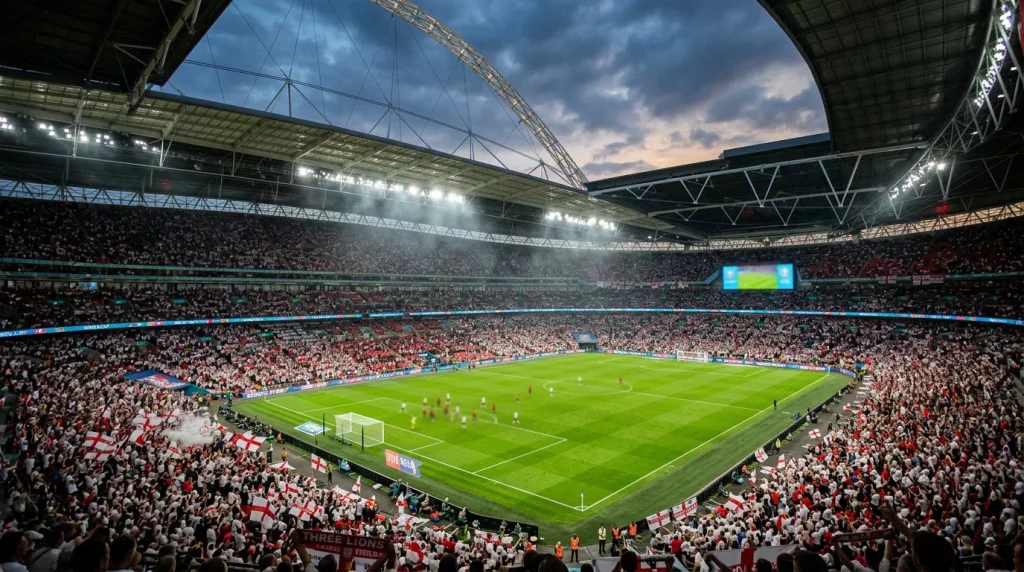
Sixty years of hurt transformed into sixty years of near-misses. Euro 2020 final — lost on penalties at home. Euro 2024 final — lost to Spain with silverware visible from the pitch. 2022 World Cup quarter-final — eliminated by France after Harry Kane skied a penalty that would have equalized. The pattern haunts English football. The England World Cup 2026 campaign enters this familiar territory: supreme talent, legitimate aspirations, and a lingering question about whether this generation can convert opportunities into trophies. Group L pairs England with Croatia (2018 semi-final conquerors), Ghana, and Panama — a draw that evokes historical ghosts while presenting a clear qualification pathway.
I have covered England at five major tournaments. The cycle repeats: early optimism, dominant group performances, and then a decisive match where composure fails or margins fall the wrong direction. Yet dismissing England as perpetual underachievers ignores the evidence. Three consecutive semi-finals or better at major tournaments (2018 World Cup, Euro 2020, Euro 2024) represent genuine progress. The squad’s quality exceeds any English generation since 1966. At current odds around 8.00-10.00, England offers value for bettors who believe variance eventually regresses toward quality.
England’s Tournament Profile
The statistical case for England begins with consistency. No other nation has reached the semi-finals or better at three consecutive major tournaments during the 2018-2024 cycle. Spain won Euro 2024 but exited the 2022 World Cup in the Round of 16. France reached the 2022 final but lost the Euro 2024 semi-final to Spain. Germany failed to escape group stages at both the 2022 World Cup and Euro 2024. England’s floor sits higher than any competitor; their ceiling — winning a trophy — remains untouched.
FIFA ranking of 4th accurately reflects England’s quality. The ranking has fluctuated between 3rd and 6th since 2018, demonstrating sustained excellence rather than tournament-to-tournament volatility. Under the current management structure, England has recorded 47 wins, 18 draws, and 11 losses across all competitions since 2018 — a 67% win rate that trails only France and Spain among European nations.
Qualification for 2026 came through UEFA’s expanded format, with England topping their group ahead of Ukraine, Serbia, and Slovenia. The qualifying campaign produced 7 wins, 2 draws, and 1 loss (away to Serbia), with 23 goals scored and 5 conceded. The defensive solidity stands out: 0.5 goals conceded per match suggests structural improvements since the 2022 World Cup, where France’s attack exposed vulnerabilities despite England’s overall quality.
Always the Bridesmaid: The Title Drought
Moscow, July 11th, 2018. I sat in the Luzhniki Stadium press area watching Croatia dismantle England’s semi-final composure through extra time. Mario Mandžukić scored the winner. The pattern established itself: England competing at the highest level, then failing at the decisive moment. Wembley in 2021 against Italy — the Euro 2020 final lost on penalties after England took the early lead. Berlin in 2024 against Spain — the Euro 2024 final where Spain’s quality ultimately prevailed despite England’s improved second-half performance. The narrative writes itself, but narratives obscure analysis.
The truth is more nuanced. England’s near-misses came against excellent opponents executing at peak levels. Italy’s 2020 squad featured Jorginho, Bonucci, and Chiellini at career peaks. Croatia’s 2018 team included Modrić and Rakitić controlling midfield with Ballon d’Or quality. Spain’s 2024 side may prove the best European Championship winner since Spain’s 2008-2012 dynasty. Losing to these opponents does not indicate psychological fragility; it indicates that margins separate elite teams, and England has landed on the wrong side of those margins.
The 2026 World Cup presents different circumstances. The expanded 48-team format reduces the number of elite opponents England must defeat to reach the final — six matches rather than seven, with weaker group-stage opponents diluting the overall difficulty. England’s bracket position, determined by Group L finishing, may produce favorable knockout draws that avoid Spain and France until the semi-finals or final. If margins are the difference, reducing the number of margin-dependent matches increases England’s probability of breakthrough.
Psychological factors deserve acknowledgment without overemphasis. England’s penalty record has improved dramatically since the 2018 World Cup (victories over Colombia and Switzerland in shootouts), suggesting that the mental blocks which plagued previous generations have been addressed through systematic preparation. The current squad contains multiple players with Champions League final experience (Bellingham, Alexander-Arnold, Rice, Saka), exposure to pressure that tournament football requires.
Squad Analysis: Generational Talent
Jude Bellingham’s emergence transformed England’s tournament ceiling. The Real Madrid midfielder — 2024 Ballon d’Or runner-up at age 21 — provides the X-factor that previous English generations lacked. His goal-scoring from midfield (15 La Liga goals in 2024-25), ability to arrive in the box at decisive moments, and leadership on the pitch elevate England beyond their sum of parts. Bellingham’s performances at Euro 2024, including the overhead kick equalizer against Slovakia that preserved England’s tournament, demonstrated big-game composure that justifies star billing. His transition from Borussia Dortmund to Real Madrid exposed him to Champions League knockout pressure that few 21-year-olds experience, preparation that translates directly to World Cup intensity.
Harry Kane remains England’s attacking centerpiece despite approaching 33. His goal-scoring record speaks for itself: 66 international goals, England’s all-time leading scorer, consistent production across Premier League and Bundesliga campaigns. At Bayern Munich, Kane has scored 45 goals in 50 appearances during 2024-25, maintaining elite output even as pace diminishes. His role for England has evolved: less pressing, more positional play, better connection with advancing midfielders. Kane does not need to carry England alone; Bellingham’s arrival distributes creative burden.
Bukayo Saka’s development addresses England’s historical weakness on the flanks. The Arsenal winger provides direct running, clinical finishing, and tactical intelligence that Raheem Sterling’s generation could not consistently deliver. Saka’s 17 Premier League goal involvements in 2024-25 ranked among the league’s best, and his understanding with Bellingham — developed through England’s youth teams — creates combination play that defenders struggle to track. Cole Palmer’s emergence offers tactical flexibility: either Saka or Palmer can operate centrally, allowing England to adjust formations without sacrificing attacking quality.
Declan Rice’s midfield presence solved England’s most significant structural issue. The Arsenal midfielder covers ground efficiently, protects the back four, and progresses possession with accuracy that previous English midfielders lacked. Rice’s statistics rank in the 90th percentile among Premier League midfielders for tackles, interceptions, and progressive passes — the complete defensive midfielder that Gareth Southgate sought throughout his tenure. Alongside Bellingham, Rice creates a midfield partnership capable of competing with any pairing at the World Cup.
The defensive core features John Stones at centre-back, whose positional discipline and ball-playing ability anchor England’s buildup. Stones’ partnership with Rúben Dias at Manchester City translates to international duty, where structure and communication prevent the individual errors that plagued England’s past. Kyle Walker’s recovery pace at right-back provides insurance against defensive mistakes, though his advancing age (36 during the tournament) raises questions about 2026 performance. Trent Alexander-Arnold offers alternative: superior distribution but defensive vulnerabilities that opponents exploit.
Jordan Pickford’s goalkeeping remains adequate rather than elite. His shot-stopping ranks around the 55th percentile among Premier League keepers, and his distribution occasionally creates unnecessary pressure. However, Pickford’s penalty shootout record — saving three penalties across major tournament shootouts — adds value beyond traditional metrics. In a team that may again face decisive shootouts, Pickford’s psychological composure matters.
Group L: Croatia, Ghana, Panama
Croatia carries the psychological weight of 2018’s semi-final victory — the match where England’s World Cup dream ended despite leading through Kieran Trippier’s early free kick. That squad has aged considerably since that Moscow evening: Modrić approaches 41, Perišić has reached 37, Brozović departed for Saudi Arabia’s league. Croatian football has not regenerated effectively; the talent pipeline that produced the 2018 generation has not delivered comparable successors capable of matching their predecessors’ achievements. Croatia’s FIFA ranking of 11th reflects historical achievement more than current capability. Against England on June 23rd in Atlanta, Croatia enters as clear underdogs despite the psychological edge from their 2018 triumph.
Ghana represents Africa’s primary challenge in Group L and brings genuine quality to the fixture. The Black Stars reached the 2022 World Cup, where they lost to Portugal and Uruguay but defeated South Korea in an entertaining 3-2 victory that showcased their attacking potential. The squad blends experienced performers (Thomas Partey providing midfield control, Mohammed Kudus offering creative threat) with emerging talent developed through European academies. Kudus’ breakout season at West Ham — 13 goals and 7 assists in 2024-25 — positions him as Ghana’s primary threat and a genuine danger in transition situations. Against England on June 17th in Kansas City, Ghana will prioritize defensive organization while seeking counterattacking moments through Kudus’ dribbling ability and Partey’s distribution from deep positions.
Panama returns to the World Cup for the first time since 2018, when they lost all three group matches (including a 6-1 defeat to England) but celebrated with infectious enthusiasm that captured neutral hearts worldwide. The Central American side qualified through CONCACAF’s competitive pathway, demonstrating tactical improvement under new management and a more pragmatic approach than their joyful 2018 campaign. Against England on June 27th in Houston (the final group match), Panama likely faces an England side already qualified and potentially rotating key players. This represents Panama’s best opportunity for a positive result, though quality differential still favors England heavily regardless of lineup selections.
England’s group-stage projection: three victories, nine points, significant goal difference. The Croatia match provides the only competitive variable, where historical baggage and Croatian tournament experience could create complications. Regardless, England should advance comfortably. The margin of victories matters for confidence heading into knockout rounds — dominant group performances establish psychological momentum that carries into elimination matches.
England Betting Odds: Markets Overview
Outright winner odds price England between 8.00 and 10.00 at major sportsbooks — third favorites behind Spain (5.50-6.50) and France (5.00-5.50). Implied probability sits around 10%-12.5%, reflecting market skepticism about England’s capacity to win decisive matches despite consistent advancement to tournament latter stages.
My assessment places England’s actual championship probability at approximately 10%-12%, meaning current odds represent roughly fair value without significant edge. The uncertainty involves execution in knockout matches — England has demonstrated capacity to reach finals and semi-finals consistently but not to win the decisive match when trophies are at stake. Whether this reflects bad luck, psychological weakness, opponent quality, or simple variance remains actively debated among analysts. The betting market essentially prices England as a team that will compete respectably but probably not lift the trophy.
Group L winner odds around 1.25-1.35 lack significant value. England’s qualification probability exceeds 95%, and group supremacy probability exceeds 85%. These prices accurately reflect expected outcomes. To-qualify markets similarly offer no edge.
Knockout-round progression presents more interesting propositions for value-seeking bettors. England to reach the semi-finals prices around 2.00-2.30 (43%-50% implied probability). Given England’s recent tournament record (three consecutive semi-finals or better across major tournaments), actual probability may exceed 50% — suggesting slight value at prices above 2.10 for those confident in England’s consistency. To reach the final: 3.00-4.00 (25%-33% implied) represents fair pricing given England’s two recent final appearances at European Championships and established knockout-round competence.
Player props offer selective opportunities. Kane’s Golden Boot odds around 12.00-15.00 reflect his goal-scoring record but also England’s historical tendency to exit before accumulating maximum matches. Bellingham’s anytime tournament scorer props (around 1.50-1.70) provide solid value given his goal-scoring role and likely match volume if England advances deep. Saka and Palmer team total goals markets merit consideration for similar reasons.
Projected Knockout Path
England’s Round of 32 opponent likely emerges from Group K (Portugal’s group) third place or Group J (Argentina’s group) runners-up. Potential opponents include Colombia, Uzbekistan, DR Congo, Algeria, Austria, or Jordan — a range of quality levels that mostly favor England significantly. Most represent beatable opposition that should not trouble England’s defensive organization, though Colombia’s tactical discipline and Uzbekistan’s defensive structure could test England’s attacking patterns and creative solutions. England enters any Round of 32 match as heavy favorites regardless of specific opponent drawn.
The Round of 16 brings more significant challenges. Group I winners (France if they top their group) or Group K runners-up (Colombia or Uzbekistan) could appear. A France-England Round of 16 rematch would generate enormous interest — these teams met at the 2022 quarter-final stage, where France prevailed 2-1 after Kane’s missed penalty. Avoiding France until later rounds benefits England’s advancement probability significantly.
Quarter-final projections depend on bracket resolution. If England and France both win their groups and advance through early rounds, they meet no earlier than the semi-finals. This scenario maximizes England’s path clarity: beatable opponents through the quarter-finals, then a decisive match against familiar opposition. The alternative — meeting France, Spain, or Argentina in the quarter-finals — reduces England’s championship probability by approximately 15-20 percentage points compared to the favorable draw scenario.
The path to the final requires navigating three knockout rounds against progressively difficult opposition while maintaining squad fitness and tactical discipline. England’s squad depth supports rotation through early rounds, preserving key players like Bellingham and Kane for decisive matches where their quality proves most valuable. Unlike 2022, when injuries depleted the squad by the quarter-finals and forced uncomfortable selection decisions, current depth allows genuine rotation without dramatic quality decline. This factor matters significantly in the expanded tournament format where seven matches (three group plus four knockout) are required to lift the trophy.
World Cup History: 1966 & Near Misses
England’s World Cup history divides cleanly at 1966. Before that July afternoon at Wembley, England had never reached a World Cup final — competitive in group stages but unable to break through to the ultimate match. Geoff Hurst’s hat-trick against West Germany delivered the trophy that defines English football’s self-image and remains the reference point for all subsequent campaigns. Since then: nothing but frustration. Semi-final defeats in 1990 (penalties against West Germany) and 2018 (Croatia in extra time). Quarter-final exits in 2002 (Brazil), 2006 (Portugal on penalties), and 2022 (France). The pattern of advancing respectably then falling short creates both pressure and opportunity for the current generation.
The 1990 squad under Bobby Robson perhaps most closely resembles the current generation. That team featured Gary Lineker’s finishing, Paul Gascoigne’s creativity, and a collective spirit that exceeded the sum of parts. They reached the semi-finals, lost on penalties to West Germany, and departed as romantic figures rather than failures. The 2026 squad carries higher expectations because quality exceeds that 1990 generation — Bellingham’s emergence alone represents a ceiling that Robson’s team could not match.
Lessons from recent tournaments inform 2026 preparation. The Euro 2020 final’s penalty failure (three consecutive misses by young players) prompted systematic shootout practice that produced victories against Colombia (2018) and Switzerland (2024). The Euro 2024 final loss to Spain revealed attacking limitations that have since been addressed through Palmer’s integration and tactical adjustments. Each near-miss provides data for improvement. Whether improvement translates to victory remains the defining question.
Overrated or Underpriced?
The debate surrounding England’s World Cup 2026 odds centers on interpretation of near-misses and whether historical patterns predict future outcomes. One perspective: England consistently chokes in decisive matches, demonstrating a psychological weakness that makes their odds appropriately discounted below France and Spain despite comparable talent levels. The alternative perspective: England has competed at the highest level against elite opponents executing at peak performance, and margins could easily have fallen differently across multiple tournaments. The truth lies somewhere between these interpretations, making betting analysis genuinely uncertain.
At 9.00 odds (midpoint of available prices), England represents fair value rather than a clear opportunity for positive expected returns. The risk involves another semi-final exit or final loss — outcomes that have occurred repeatedly and could plausibly repeat given the pattern established. The upside involves bracket variance producing favorable draws and margins finally falling England’s way after years of near-misses. For Canadian bettors seeking European exposure, England offers quality comparable to Spain and France without the compressed odds those favorites carry.
The squad’s quality is undeniable. Bellingham, Kane, Saka, Rice, and Stones would start for most national teams at this World Cup. The tactical system has stabilized under consistent management philosophy that prioritizes defensive solidity and efficient attacking transitions. The psychological demons — penalty shootouts, semi-final nerves, final-match composure — have been partially addressed through accumulated experience and systematic preparation protocols. What remains uncertain is whether quality and preparation translate to trophy success when the moment arrives.
England enters 2026 as legitimate contenders carrying sixty years of burden and expectation. The Three Lions have produced three consecutive semi-finals or better — unprecedented consistency in modern English football history that demonstrates sustained competitiveness at the highest level. Converting consistency to championship requires margins falling favorably once, in the decisive match, against an elite opponent willing to be beaten. The opportunity will arise during this tournament. Whether England seizes it determines whether this generation achieves greatness or adds another chapter to the narrative of glorious failure. The Group L breakdown provides detailed analysis of England’s path through the group stage.
