
Complete World Cup 2026 Betting Guide for Canadians
 Available in US
I placed my first World Cup bet in 2014 — a parlay on Germany to win and Miroslav Klose to score. Germany lifted the trophy, Klose broke the all-time goals record, and I walked away thinking I had this figured out. Four years later, I watched Germany crash out in the group stage with defending champion odds of 5.00. Tournament betting humbles everyone eventually. After nine years of covering international football markets, what separates profitable World Cup betting from expensive entertainment comes down to understanding how this tournament uniquely punishes conventional wisdom. The 2026 FIFA World Cup introduces a 48-team format that rewrites every betting playbook. This guide breaks down what Canadian bettors need to know before June 11, 2026.
Key Numbers for Bettors
The numbers behind the 2026 World Cup reveal why this tournament demands a completely different betting approach than any previous edition. Start with the format expansion: 48 teams competing across 104 matches over 39 days, compared to 32 teams playing 64 matches in 29 days at Qatar 2022. The mathematical implications cascade through every market you consider.
Group stage dynamics shift dramatically with 12 groups of 4 teams each. Under the new qualification rules, the top 2 from each group advance automatically, plus 8 best third-place finishers — meaning 32 of 48 teams (66.7%) reach the knockout rounds. Compare this to previous World Cups where 50% of teams advanced. Third place in your group now carries genuine value, transforming how you should approach group winner and qualification markets.
For Canadian bettors specifically, the home advantage data demands attention. Across the last 10 World Cups, host nations have advanced from the group stage 92% of the time. With matches spread across USA (78 matches at 11 venues), Mexico (13 matches at 3 venues), and Canada (13 matches at 2 venues), three nations enjoy home soil. Canada plays two of three group matches in Canadian venues — BMO Field in Toronto and BC Place in Vancouver — against Bosnia and Herzegovina, Qatar, and Switzerland.
The expanded knockout bracket means 16 matches in the Round of 32, compared to the Round of 16 starting point in previous tournaments. One extra knockout round adds 16 matches to the tournament schedule, each representing fresh betting opportunities but also compounding variance. A team reaching the final now survives six knockout matches instead of four, making outright winner bets inherently riskier in a 48-team field.
The Canadian Betting Landscape: Quick Overview
Three years ago, betting on a single sporting event in Canada meant either using offshore sites operating in legal grey areas or traveling to a brick-and-mortar casino. Bill C-218 changed everything in August 2021, legalizing single-game sports betting across the country. I remember the shift vividly — suddenly the parlay-only restrictions that had defined Canadian sports wagering for decades disappeared overnight.
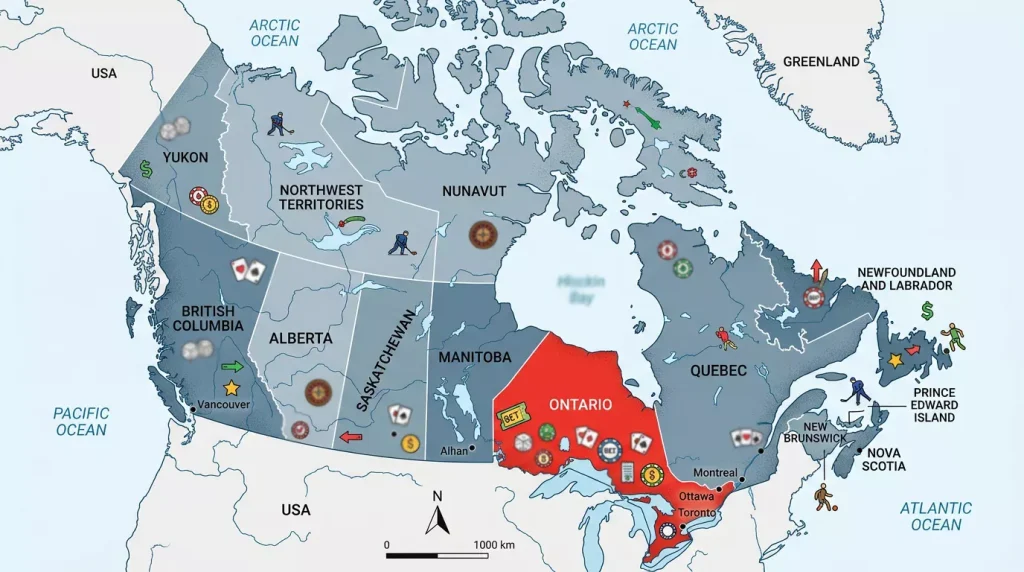
Provincial regulation creates the framework you need to understand. Ontario operates the only competitive private market in Canada, launching in April 2022 through the Alcohol and Gaming Commission of Ontario (AGCO). Over 40 licensed operators now compete for Ontario bettors, including international brands like bet365, DraftKings, FanDuel, and BetMGM alongside Canadian-focused operators. If you live in Ontario, you access the same competitive odds and promotions that American bettors have enjoyed for years.
Other provinces maintain government-run monopolies through provincial lottery corporations. British Columbia operates through BCLC’s PlayNow platform. Alberta’s AGLC runs PlayAlberta, though the province announced plans to open a competitive market potentially by 2026 — timing that could coincide with the World Cup. Quebec’s Loto-Québec offers Mise-o-jeu. These provincial platforms provide legal, regulated options, though often with less competitive odds than private operators.
The regulatory landscape continues evolving as the World Cup approaches. Bill S-211, currently under Senate consideration, proposes advertising restrictions that could limit celebrity endorsements and promotional messaging. Ontario’s AGCO already prohibits advertisements featuring athletes and celebrities for anything beyond responsible gambling initiatives. For bettors, this regulatory activity signals a maturing market focused on consumer protection without eliminating access to legal wagering.
One practical reality: Canadian bettors should verify provincial licensing before depositing funds anywhere. AGCO publishes a registry of licensed operators for Ontario. Other provinces restrict legal betting to their government platforms. Using licensed, regulated operators ensures access to dispute resolution processes and guarantees your funds remain protected under Canadian law.
Payment methods vary by operator and province. Credit cards, debit cards, e-wallets like PayPal and Interac, and bank transfers provide deposit and withdrawal options. Some operators restrict credit card deposits following responsible gambling best practices. Interac e-Transfer has become the Canadian standard for fast transactions with minimal fees. Always verify withdrawal timeframes and limits before committing significant deposits — processing times range from instant e-wallet withdrawals to 3-5 business day bank transfers.
World Cup Bet Types Explained
A colleague once told me that understanding bet types is like learning chess — the rules take minutes, but the strategy takes years. The 2026 World Cup offers betting markets ranging from the straightforward to the absurdly specific, and knowing which fit your analysis style matters more than chasing every available option.
Moneyline and Match Result (1X2)
The most fundamental World Cup bet asks a simple question: who wins this match? In soccer’s three-way market (1X2), you choose home win (1), draw (X), or away win (2). Group stage matches can end in draws, making this market distinct from knockout rounds where extra time and penalties produce a winner. The draw outcome typically offers value that casual bettors underestimate — across the 2022 World Cup group stage, 6 of 48 matches (12.5%) ended level after 90 minutes.
Tournament designation replaces traditional home/away designations in World Cup betting. The first-listed team receives the “home” designation for betting purposes regardless of venue. Canada, playing at BMO Field in Toronto against Bosnia and Herzegovina, receives the 1 designation despite both teams technically being visitors to a neutral World Cup venue — though Canada’s home crowd advantage remains very real.
Point Spread and Asian Handicap
When favorites carry heavy moneyline prices, spread betting levels the playing field. Asian handicap eliminates the draw by applying fractional or whole number handicaps. A -1.5 spread on Spain means they must win by 2+ goals for your bet to cash. Quarter-ball handicaps (-0.25, -0.75) split your stake between adjacent whole numbers, reducing variance at the cost of complexity.
World Cup knockout matches demand particular attention to spread betting. Extra time and penalties only count for some markets — verify whether your spread bet includes the full 120 minutes or only regulation 90. Most operators settle Asian handicaps on 90-minute results, meaning a 1-1 draw going to penalties affects your handicap bet differently than your match winner bet.
Totals (Over/Under)
Goal totals present some of the most consistent World Cup betting opportunities. The standard line sits at 2.5 goals — will the match produce 3+ goals (over) or 0-2 goals (under)? Historical World Cup data shows average goals per match hovering between 2.4 and 2.8 across recent tournaments. The 2022 World Cup averaged 2.69 goals per match, slightly above the 2.5 standard line.
The expanded 48-team format introduces quality mismatches that previous World Cups rarely produced. When top-ranked nations face debutants like Curaçao or Cape Verde, team total overs on favorites carry logical appeal. Individual team totals — Spain over 1.5 team goals, for instance — often provide better value than match totals in lopsided fixtures.
Outright and Futures Markets
Outright winner betting asks you to predict the champion before the tournament begins. Current odds show Spain at approximately 6.00, France at 6.50, England at 7.00, Argentina at 8.00, and Brazil at 9.00. These prices reflect implied probabilities between 11-17% for each favorite, acknowledging that the 48-team format introduces unprecedented uncertainty.
Group winner markets offer mid-range futures opportunities. Betting Canada to win Group B at 3.50 pays better than match-by-match wagers if you believe they finish atop Switzerland, Qatar, and Bosnia and Herzegovina. Top scorer (Golden Boot), best young player, and tournament MVP markets round out the futures slate, though liquidity on these props varies significantly between operators.
Prop Bets and Specials
Proposition bets range from player-specific (Kylian Mbappé to score anytime at 1.85) to tournament-wide (any host nation to reach semifinals at 2.10). These markets reward deep knowledge of team composition, tactical tendencies, and historical patterns. Player cards, corner totals, first goalscorer, and exact score markets provide granular betting opportunities throughout each match.
Tournament specials unique to the World Cup include highest-scoring group, group stage elimination for specific favorites, and whether any host nation reaches the final. The 2026 format creates entirely new specials around the third-place qualification pathway and Round of 32 matchups.
Parlay and Accumulator Betting
Parlays combine multiple selections into a single bet where all legs must win for the bet to pay. The mathematical appeal is seductive — a three-team parlay at 2.00 each returns 8.00, turning $100 into $800. The mathematical reality is brutal: winning percentage drops exponentially with each added leg. A bettor hitting 55% on individual bets hits only 30% on three-leg parlays and 17% on four-leg parlays.
If you insist on parlay betting during the World Cup, limit yourself to two or three legs and seek uncorrelated events. Spain to beat their Group H opponent and England to beat their Group L opponent represent independent events — one result doesn’t influence the other. Same-game parlays where Spain wins and both teams to score correlate outcomes that compound your risk beyond the odds suggest.
Round robin bets offer parlay-adjacent action with reduced variance. A three-team round robin creates three separate two-team parlays, meaning two of three selections winning still produces some return. This structure acknowledges tournament uncertainty while capturing parlay-style payouts on successful selections.
Understanding Odds Formats: Decimal vs American
I once spent 20 minutes explaining decimal odds to a friend from Chicago who couldn’t understand why 2.50 meant anything to anyone. His confusion was reasonable — odds formats are arbitrary conventions, and Canadian bettors encounter both decimal (European) and American systems depending on which platform they use.
Decimal odds dominate Canadian sportsbooks. The calculation is beautifully simple: multiply your stake by the decimal to find your total return. A $100 bet at 3.25 returns $325 total ($225 profit plus your $100 stake). Provincial platforms and most international operators default to decimal format, making it the practical standard for Canadian betting.
American odds use positive and negative numbers. Positive odds (+250) show profit on a $100 stake — you would win $250 plus your $100 back. Negative odds (-150) show how much you must stake to win $100 — risking $150 to profit $100. American operators entering Ontario’s market, including DraftKings and FanDuel, default to American format but allow switching to decimal in account settings.
Converting between formats follows straightforward formulas. Decimal to American: if decimal is 2.00 or higher, American = (decimal – 1) × 100; if below 2.00, American = -100 ÷ (decimal – 1). For practical purposes, 2.00 decimal equals +100 American (even money). Most experienced bettors develop intuitive conversions for common odds ranges rather than calculating each time.
Implied probability — the percentage chance odds suggest — matters more than the format itself. Decimal odds of 4.00 imply 25% probability (100 ÷ 4). American odds of +300 also imply 25% (100 ÷ 400). When comparing lines across operators, focus on implied probability rather than getting distracted by format differences. A 3.80 decimal line beats a +260 American line (3.60 decimal equivalent) for the same outcome.
Bankroll Management for Tournament Betting
The 2018 World Cup taught me an expensive lesson about tournament bankroll management. Convinced that Germany would bounce back after a poor first match, I increased my stakes on their second game — then watched them lose to South Korea and exit in the group stage. Proper bankroll management would have contained that damage. Instead, one defending champion’s collapse torpedoed my entire tournament betting account.
Establish a dedicated tournament bankroll before June 11, 2026. This amount should represent money you can afford to lose entirely without affecting your financial stability. For recreational bettors, this might mean $200-500 across the tournament’s 39 days. More serious bettors might allocate $2,000-5,000. The specific amount matters less than the discipline of treating it as a fixed budget.
Unit sizing creates structure within your bankroll. A standard approach allocates 1-2% of your bankroll per bet as a single unit. With a $1,000 tournament bankroll, one unit equals $10-20. High-confidence plays might warrant 2-3 units; speculative props get half a unit. This system allows you to express varying conviction levels without exposing your entire bankroll to any single outcome.
The 104-match tournament schedule demands patience that shorter events don’t require. Spreading 50-100 units across 39 days averages roughly 2-3 units of action daily. Resist the temptation to chase losses after a bad day — the tournament provides built-in recovery opportunities that week-long events don’t offer. Similarly, don’t dramatically increase stakes after a winning streak. Variance normalizes over sample sizes, and what feels like a hot hand often regresses sharply.
Track your results systematically. A simple spreadsheet recording date, match, bet type, odds, stake, and result reveals patterns in your betting performance. After the tournament, you’ll have data showing whether your strength lies in group stage overs, knockout round props, or outright futures. This record transforms World Cup 2026 betting into a learning experience for future tournaments.
Consider separating your bankroll into phase-specific allocations. I typically reserve 40% for group stage betting, 35% for knockout rounds through quarterfinals, and 25% for semifinals and final. This structure prevents burning through your bankroll before the tournament reaches its most exciting stages. It also forces discipline during the early group matches when action flows constantly and overexposure temptations peak.
Withdrawal discipline completes the bankroll management picture. If you double your tournament bankroll by the knockout rounds, withdrawing your original stake locks in guaranteed profits. The remaining winnings become house money — psychologically and financially liberated from loss aversion. Conversely, if you lose 50% of your bankroll during the group stage, reducing unit sizes to 1% rather than chasing at 2% extends your tournament runway and improves recovery probability.
Strategic Approaches to World Cup Betting
The most profitable World Cup bet I ever placed came from watching a Tuesday morning training session video that went viral four hours before kickoff. A key midfielder was visibly limping, information that hadn’t yet reached mainstream betting markets. By the time injury reports confirmed what I had seen, the line had moved 0.3 points. That edge came not from sophisticated modeling but from paying attention when others weren’t.
Information Timing and Line Movement
World Cup markets generate enormous global liquidity, making sharp line movement a reliable signal. When Argentina’s match winner odds drift from 1.60 to 1.75 in the hours before kickoff, something has changed — probable lineup news, weather conditions, or sharp money on the underdog. Following line movement through odds comparison services reveals market consensus shifts that single-operator odds obscure.
Injury and suspension news drives the most significant pre-match line movement. International tournaments force national teams to navigate compressed schedules with limited squad depth. A yellow card accumulation suspension keeping a starting center-back out of a knockout match creates immediate betting implications. Monitor official team announcements, press conferences, and training reports from credible journalists covering each camp.
Group Stage Value Opportunities
The group stage offers the World Cup’s most predictable betting landscape. Fixture schedules are known months in advance. Team quality gaps are more clearly defined than in knockout football, where single-game variance increases upset frequency. I focus approximately 60% of my tournament betting volume on group stage matches, where form guides and historical patterns provide useful baselines.
Third-place qualification scenarios create unique strategic opportunities in the new format. Because 8 of 12 third-place teams advance, understanding goal difference tiebreakers adds value to late group stage betting. A team needing a draw to secure third place behaves differently than one needing maximum goal difference improvement. Betting live during matches where qualification scenarios crystallize often produces better value than pre-match markets.
Knockout Round Adjustments
Single-elimination football introduces variance that regular season betting cannot replicate. The 2022 World Cup saw Morocco reach the semifinals at 150.00 pre-tournament odds. Portugal crashed out to Morocco despite entering as comfortable favorites. Penalty shootouts decided two quarterfinals. If your group stage approach works, resist the temptation to apply it unchanged to knockout matches where 90-minute results often mislead.
Match total unders gain value in high-stakes knockout football. Teams tighten defensively when elimination looms. The 2022 quarterfinals averaged 2.0 goals per match; the semifinals produced a combined 5 goals across two matches. Tournament fatigue compounds conservative tactics as the bracket narrows. Under 2.5 goals on a semifinal match, priced at 1.75-1.85, often represents better value than similar group stage unders.
Live Betting and In-Play Markets
Live betting transforms World Cup matches into continuous opportunities lasting 90+ minutes. The information advantage shifts dramatically once kickoff occurs — you see tactical setups, player energy levels, and match flow that pre-match analysis could only guess. I allocate roughly 30% of my World Cup betting to in-play markets, particularly in knockout matches where teams adjust strategies based on scoreline and time remaining.
Goal expectancy models become especially valuable in live scenarios. A 0-0 match at the 60-minute mark involving two attacking teams often produces better over 1.5 goals prices than pre-match, despite the reduced time remaining. Conversely, a 1-0 match with dominant possession and expected goals metrics suggests the leading team scores again. Understanding xG (expected goals) data, now widely available through analytics platforms, sharpens live betting decisions.
Tempo changes create exploitable moments. A team chasing a late equalizer pushes numbers forward, increasing both goal-scoring probability and defensive vulnerability. The substitution patterns around the 70th minute signal tactical intentions — attacking changes suggest commitment to scoring, while defensive swaps indicate protecting the result. Reading these signals faster than the market adjusts creates live betting edges.
Weather and Environmental Factors
The 2026 World Cup spans venues from Mexico City’s 2,240-meter altitude to Miami’s sea-level humidity across June and July summer conditions. Environmental factors influence match outcomes in predictable ways that betting markets occasionally neglect. Altitude affects aerobic capacity — teams unaccustomed to thin air tire faster and struggle with ball flight. European and Asian teams playing their first match at Estadio Azteca face genuine physiological disadvantages.
Heat management separates prepared teams from unprepared ones. Matches in Houston, Miami, and Dallas during late June can see temperatures exceeding 35°C with significant humidity. Cooling breaks and hydration protocols help, but teams from cooler climates historically underperform in extreme heat. Check match time scheduling — 1 PM local kickoffs create harsher conditions than 8 PM evening matches in the same venue.

7 Costly Mistakes to Avoid
My worst World Cup betting year came not from backing wrong teams but from compounding fixable errors. I violated principles I knew well, convinced that tournament excitement justified exception-making. These seven mistakes cost me more than any specific bad pick — and I watch bettors repeat them every four years.
Overweighting recent form. Club season form translates imperfectly to international tournaments. Players who struggled in domestic campaigns sometimes peak when representing their countries; dominant club performers occasionally disappear in tournament settings. The mental shift, tactical adjustments, and different teammates create discontinuities that form tables cannot capture.
Ignoring time zone and travel fatigue. Teams crossing multiple time zones face physiological disadvantages that oddsmakers frequently undervalue. A South American squad playing their first match in Vancouver after an 8-hour time zone shift performs differently than European teams with minimal travel. The 2026 format’s North American span from Vancouver to Miami creates significant east-west travel demands.
Chasing losses during the group stage. Early exits by favorites trigger emotional betting among fans and casual bettors. When Germany lost their opener in 2018, money poured onto their second match at deflated odds. That reactionary betting inflates favorite prices for subsequent matches while creating value on opponents. Recognize when you’re betting with emotion rather than analysis.
Overloading parlays with correlated legs. A parlay combining Argentina to win, Argentina over 2.5 team goals, and Lionel Messi to score seems coherent but fails to add genuine diversification. If Argentina gets a 1-0 winner from a Messi penalty, two of three legs lose. True parlay value comes from independent events, not thematically linked outcomes on the same match.
Betting every match. The 104-match schedule creates 104 betting opportunities but demands 104 analytical efforts. Casual bettors who wager every match inevitably bet on games they haven’t researched. Selectivity correlates with profitability; forced action on obscure Group F matches rarely produces positive expected value.
Misunderstanding market settlement rules. Does your outright winner bet include extra time and penalties? Do Asian handicaps settle on 90 minutes or full time? When does a player prop require full 90 minutes to qualify? Reading settlement rules before betting prevents disputes and disappointment. Each operator publishes these rules; failing to check them before a significant wager represents avoidable negligence.
Ignoring hedging opportunities. Futures bets placed before the tournament create hedging possibilities as teams advance. If you hold an Argentina outright ticket at 12.00 and they reach the final, a hedge on their opponent locks in guaranteed profit regardless of the final result. Calculating optimal hedge amounts — and executing them without emotional attachment to “letting it ride” — separates sophisticated bettors from gamblers.
Your Tournament Betting Foundation
The 2026 World Cup betting guide comes down to preparation meeting opportunity across 39 days and 104 matches. Canadian bettors now enjoy legal, regulated access through provincial platforms and Ontario’s competitive private market. The 48-team format rewrites historical baselines while creating fresh value opportunities for those who adapt their strategies.
Master the bet types that fit your analysis style. Understand how decimal and American odds express the same underlying probabilities. Establish a tournament bankroll with unit sizing that survives inevitable losing streaks. Develop a strategic framework emphasizing information timing, group stage value, and knockout round adjustments. Avoid the seven mistakes that compound across a long tournament.
I return to World Cup betting every four years because no other sporting event combines global attention with concentrated opportunity. The next tournament brings Canada’s first home World Cup matches since 1986 — actually the first ever, since that tournament was solely in Mexico despite Canadian qualification. Canada’s path through Group B adds local stakes to global spectacle. Whatever your motivation, approach the tournament with discipline, and you’ll find the 2026 World Cup as rewarding as any four-year cycle in betting history.
