
USA at World Cup 2026: Host Nation Odds & Home Advantage
 Available in US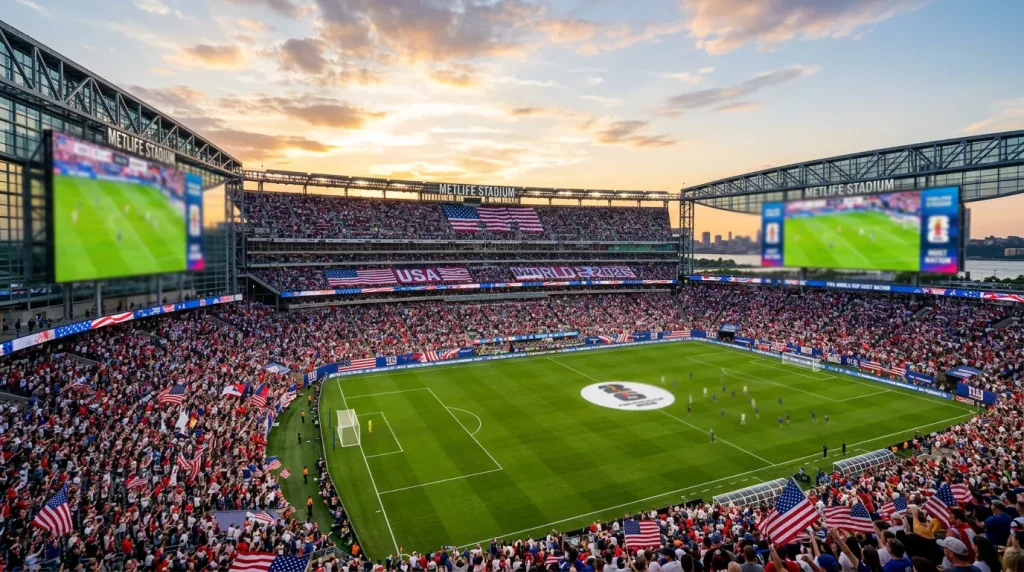
Eleven stadiums. Seventy-eight matches. The largest World Cup hosting footprint in tournament history. The United States enters World Cup 2026 not merely as participants but as the primary stage for football’s biggest event. I have covered tournaments in Brazil, Russia, and Qatar, each with unique hosting dynamics. None approach the scale of what America will experience in summer 2026 — matches from Seattle to Miami, New York to Los Angeles, with the final at MetLife Stadium in East Rutherford. The USA World Cup 2026 campaign combines unprecedented home advantage with a golden generation of American talent finally ready to deliver on decades of promise.
Group D places the USMNT alongside Australia, Paraguay, and Türkiye. No group-stage match occurs outside American borders; all three fixtures take place in US stadiums packed with American supporters. The contrast with Canada (co-hosts with fewer venues) and Mexico (co-hosts with historical home-field precedent) is stark. The United States controls this tournament’s infrastructure, atmosphere, and energy. Whether that translates to results depends on a squad that reached the Round of 16 in 2022 but has struggled to advance beyond that stage since their surprise 2002 quarter-final run.
USA’s Host Profile
The numbers tell the hosting story. The United States will stage 78 of 104 total matches including the final, both semi-finals, and seven of eight quarter-finals. Eleven stadiums across the country — MetLife (New Jersey), SoFi (Los Angeles), Hard Rock (Miami), AT&T (Dallas), NRG (Houston), Mercedes-Benz (Atlanta), Lumen Field (Seattle), Levi’s (Santa Clara), Lincoln Financial (Philadelphia), Gillette (Foxborough), and Arrowhead (Kansas City) — create the tournament’s infrastructure. No previous World Cup has concentrated hosting duties this heavily in one nation.
Historical precedent for hosts shows positive results. The 1994 World Cup saw the United States reach the Round of 16 as hosts, losing to Brazil 1-0. South Korea reached the semi-finals in 2002 as co-hosts. Russia topped their group and reached the quarter-finals in 2018. France won as hosts in 1998. The pattern holds across decades: home advantage produces outcomes that exceed pre-tournament expectations. The crowd support, familiar conditions, minimal travel, and psychological comfort combine to elevate performance.
The USMNT’s FIFA ranking of 14th represents a historic high achieved through consistent competitive results since the 2022 World Cup. The ranking has stabilized between 12th and 16th for two years, reflecting genuine quality improvement rather than scheduling anomalies. American players now compete regularly at Europe’s highest levels — Premier League, Bundesliga, Serie A — and bring that experience to international duty. The gap between the USMNT and traditional powers has narrowed, even if it has not closed entirely.
Home Advantage: 11 Stadiums, 78 Matches
Consider the practical advantages. The USMNT will train at familiar facilities, sleep in their own time zones, and play before crowds that treat World Cup matches as generational events. American fans — many attending their first World Cup on home soil — will create atmospheres that match or exceed traditional football nations. I have watched American crowds at major tournaments; the enthusiasm compensates for lack of traditional supporter culture. Seventy thousand fans at MetLife or SoFi will produce noise levels that unsettle opponents accustomed to hostile away environments.
Group D scheduling maximizes home advantage. The United States opens against Türkiye at SoFi Stadium in Los Angeles (June 14), faces Paraguay at Mercedes-Benz Stadium in Atlanta (June 18), and concludes against Australia at Levi’s Stadium in San Francisco (June 24). These venues span the country but remain American territory — American infrastructure, American support staff, American energy. No adjustment period required; no unfamiliar conditions to navigate.
Travel distances favor American players throughout the tournament. If the USMNT advances from Group D, knockout matches remain on American soil through the semi-finals at minimum. The contrast with European and South American teams who fly cross-continental, adjust to time zones, and play in unfamiliar climates cannot be overstated. By the quarter-finals and semi-finals, accumulated travel fatigue disadvantages opponents who have crossed oceans while Americans have merely crossed state lines.
The crowd advantage extends beyond raw numbers. American soccer culture has evolved dramatically since 1994. Major League Soccer’s growth has produced genuine supporter groups with European-style organization. The US national team’s following has expanded through qualification cycles and global streaming access. Mexican-American, Colombian-American, and other diaspora communities add layers of passion. When the United States plays at MetLife, the stadium becomes a fortress that Argentina or Germany must breach — a dynamic that favors underdogs and complicates favorites’ paths.
Squad Analysis: Golden Generation
The term “golden generation” gets overused in football, but the current USMNT roster justifies it. Christian Pulisic (AC Milan), Weston McKennie (Juventus), Tyler Adams (Bournemouth), Gio Reyna (Borussia Dortmund), and Yunus Musah (AC Milan) represent the first American generation to earn regular minutes at Champions League clubs. Their technical foundations exceed previous American cohorts; their tactical educations occurred in elite European academies; their physical profiles match international standards without relying on athleticism alone.
Pulisic serves as captain and creative catalyst. His 2024-25 Serie A season produced 11 goals and 9 assists, confirming that his Chelsea struggles reflected fit rather than quality. At AC Milan, Pulisic operates as an inverted winger cutting inside onto his preferred right foot — the same role he executes for the USMNT. His dribbling success rate (62%) ranks among Europe’s best, and his final-ball quality has improved since the 2022 World Cup. At 27 during the tournament, Pulisic enters his peak years with the opportunity to define American soccer history on home soil.
Weston McKennie provides midfield dynamism that connects defense to attack. His Juventus performances have established him as a box-to-box contributor capable of scoring crucial goals (7 Serie A goals in 2024-25) while maintaining defensive responsibilities. McKennie’s aerial ability adds set-piece threat, and his understanding with Pulisic — developed through years of international partnership — creates combination play that opponents struggle to anticipate. The McKennie-Musah-Adams midfield trio provides balance that previous American teams lacked.
Gio Reyna’s talent remains undeniable despite injury-disrupted development. The Borussia Dortmund attacker possesses technical quality that rivals any American player ever produced — his first touch, passing range, and shooting technique would grace any European national team. The challenge involves consistency and availability; Reyna has completed only 22 Bundesliga matches since September 2024 due to various injuries. If fit, Reyna provides creative options from wide positions or as a number ten. If unavailable, the USMNT loses a dimension that lacks easy replacement.
The striking position presents tactical flexibility. Folarin Balogun (Monaco) has emerged as the primary option following his decision to represent the United States over England. His 2024-25 Ligue 1 output (14 goals, 6 assists) reflects genuine quality, and his hold-up play gives the USMNT a focal point that previous American teams lacked. Ricardo Pepi (PSV Eindhoven) provides alternative with different strengths — more pace, less link-up play. Josh Sargent (Norwich) offers depth if Premier League return materializes. The position’s depth exceeds historical American standards.
Defensively, the spine requires clarification. Matt Turner’s goalkeeping has improved at Crystal Palace, though questions linger about his distribution and command. Centre-back partnerships remain unsettled — Tim Ream’s age (38), Miles Robinson’s recovery from injury, and Mark McKenzie’s inconsistency create rotation concerns. Full-back depth looks stronger with Antonee Robinson (Fulham) and Joe Scally (Borussia Mönchengladbach) providing Premier League and Bundesliga quality. The defensive organization will determine whether home advantage translates to results or merely atmosphere.
Group D: Australia, Paraguay, Türkiye
Türkiye represents Group D’s most dangerous opponent. The Turkish national team under current management has produced inconsistent results but possesses individual quality through Arda Güler (Real Madrid), Kenan Yıldız (Juventus), and Hakan Çalhanoğlu (Inter Milan). Turkish supporters in America — concentrated in Northeast cities — will contest crowd advantages in ways that Australia and Paraguay cannot. The opening match on June 14th at SoFi Stadium sets the tone: a victory establishes control; a draw or loss creates pressure that home advantage cannot fully offset.
Australia’s Socceroos return under different circumstances than their 2022 breakthrough. That squad reached the Round of 16 (their first since 2006) but has subsequently struggled with generational transition. The Australian attack lacks the firepower that Mathew Leckie and Mitchell Duke provided in Qatar, and defensive organization has declined. Against the USMNT on June 24th in San Francisco, Australia will deploy deep defensive blocks while seeking counterattacking moments. The United States should control this match; the margin determines Group D’s final shape.
Paraguay’s qualification demonstrates CONMEBOL’s continued strength but does not suggest upset potential against home hosts. The Paraguayan national team has lacked tournament success since their 2010 quarter-final run, and the current squad features domestic-based players alongside European fringe performers. Against the USMNT on June 18th in Atlanta, Paraguay will prioritize organization over ambition. Three points appear likely for the United States; the performance quality matters for confidence heading into knockout rounds.
Group D projection: seven to nine points, first or second place depending on the Türkiye result. The USMNT should defeat Australia and Paraguay comfortably given quality differential and home advantage; the Türkiye match determines group supremacy and carries weight beyond mere standings. Topping the group provides favorable bracket positioning — avoiding potential Round of 32 matches against Group C winners (Brazil or Morocco) in favor of theoretically weaker opposition from lower-seeded groups. This strategic dimension adds weight to the opening fixture that already carries enormous emotional significance for a nation hosting its first World Cup in 32 years.
USA Betting Odds: Host Premium
Outright winner odds price the United States between 25.00 and 35.00 at major sportsbooks — typically ninth or tenth favorites. Implied probability sits around 3%-4%, reflecting bookmaker skepticism about American championship potential despite home advantage. This pricing appears slightly compressed compared to historical norms for mid-tier teams, suggesting the host premium has been partially incorporated but may offer value if you believe home advantage exceeds market expectations.
My assessment places the USMNT’s actual championship probability at approximately 3%-5%, depending on bracket draws and key player availability. The range reflects genuine uncertainty: a healthy squad in favorable bracket positions could reach the semi-finals, while injuries or difficult draws could produce Round of 16 elimination that matches historical patterns. At 30.00 odds, fair pricing exists without significant edge; at 35.00 or higher, slight value emerges for believers in home-field dominance.
Group D winner odds around 2.00-2.40 represent the most interesting market. The USMNT’s probability of topping their group exceeds 45% given home advantage, quality differential over Australia and Paraguay, and competitive balance against Türkiye. Odds above 2.20 offer positive expected value; odds below 2.00 accurately price the competitive factors. The Türkiye match effectively determines group supremacy — a fact the market has incorporated efficiently.
Qualification odds around 1.20-1.30 (77%-83% implied) accurately reflect the USMNT’s overwhelming likelihood of advancing from Group D. Even a third-place finish would likely qualify given the expanded format; second place is virtually guaranteed if the USMNT performs at expected levels. No significant edge exists here.
Knockout-round progression provides nuanced opportunities. USA to reach the quarter-finals prices around 3.00-3.50 (29%-33% implied). Given home advantage and likely Round of 32/16 opponents, actual probability may approach 40%, suggesting value at higher prices. USA to reach the semi-finals: 5.00-7.00 (14%-20% implied) represents speculative territory where bracket variance determines outcomes more than fundamental quality assessments.
Projected Knockout Path
The USMNT’s Round of 32 opponent likely emerges from Group C (Brazil’s group) third place or Group E (Germany’s group) runners-up. Potential opponents include Scotland, Haiti (both theoretically beatable), Morocco (dangerous), or Ecuador (competitive). The bracket structure suggests winnable Round of 32 matches if the USMNT avoids Morocco — the one opponent with demonstrated capacity to upset superior teams through tactical organization.
Round of 16 opponents become more challenging. Group B winners (Switzerland or Canada) or Group A runners-up (South Korea, South Africa, or Czechia) represent likely draws. A USMNT-Canada Round of 16 match would generate enormous continental interest and genuine uncertainty about outcomes. Switzerland would represent the toughest test — a tactically sophisticated European side that reached the Euro 2024 quarter-finals. Either match remains winnable given home advantage; neither guarantees advancement.
Quarter-final projections depend heavily on bracket resolution. If the USMNT wins Group D and advances through two knockout rounds, likely quarter-final opponents include France, England, or Spain — elite teams that would be heavily favored regardless of home advantage. This is where American tournament ceilings historically reside: competitive through the Round of 16, outclassed in the quarter-finals by superior European or South American powers. Breaking that pattern requires either extraordinary home advantage impact or simply playing better football than previous American generations managed.
World Cup History: 1994 & Beyond
American World Cup history divides at 1994. Before hosting that tournament, the United States had not qualified since 1950 and possessed minimal football infrastructure or culture. The decision to award America the 1994 World Cup — controversial at the time — transformed the sport’s domestic trajectory. Major League Soccer launched in 1996. Youth development pathways professionalized. The player pool expanded beyond ethnically-driven communities into mainstream American athletics.
Since 1994, the USMNT has qualified for every World Cup except 2018 (the infamous Trinidad and Tobago defeat that sent shockwaves through American soccer) and achieved notable results across seven tournament appearances: Round of 16 in 1994 (lost to Brazil 1-0), quarter-finals in 2002 (lost to Germany 1-0 on a controversial non-call that remains disputed), Round of 16 in 2010 (lost to Ghana 2-1 in extra time after leading), Round of 16 in 2014 (lost to Belgium 2-1 in extra time after Tim Howard’s record-setting performance), and Round of 16 in 2022 (lost to Netherlands 3-1 in what proved a more decisive defeat). The pattern emerges: competitive advancement through group stages, respectable knockout exits, and a clear ceiling around the Round of 16/quarter-finals boundary that this generation must shatter.
The 2026 tournament represents the opportunity to shatter that ceiling. Home advantage at the scale America provides has no historical precedent — even South Korea’s 2002 semi-final run occurred with fewer home matches and more skeptical crowds. If the USMNT can leverage crowd support, familiar conditions, and reduced travel into tournament advancement, a semi-final appearance becomes genuinely achievable. The final remains unlikely given quality gaps against Spain, France, and Argentina. But reaching the final four would transform American soccer’s status permanently.
Overhyped or Real Contender?
The USMNT enters 2026 surrounded by justified hype and appropriate skepticism. The golden generation label fits — these players represent genuine quality at top European clubs. Home advantage at this scale has never been tested. The squad’s tactical education under various club systems provides flexibility that previous American teams lacked. The pieces exist for tournament success that exceeds historical patterns.
The concerns involve execution under pressure and quality gaps against elite opponents. American players have not demonstrated the decisive tournament performances that define generational talents — Pulisic’s injuries at key moments, Reyna’s availability questions, McKennie’s occasional lapses in concentration. Against organized European defenses or South American flair, the USMNT may simply lack the individual quality to create solutions when systems are matched and games tighten in knockout rounds. Home advantage provides meaningful edges in crowd support and familiarity but does not guarantee results against superior technical quality.
The coaching factor adds another variable. Gregg Berhalter’s reappointment following the 2022 World Cup drew mixed reactions from American soccer observers. His system — position-based play with emphasis on ball progression through midfield — has produced qualifying success but tournament questions remain about knockout-round adjustments. The capacity to adapt tactically against elite opponents who have studied American patterns will determine whether home advantage translates to advancement or merely respectful elimination.
At 28.00-32.00 odds (mid-range of available prices), the USMNT offers speculative value for those who believe home advantage exceeds market pricing. The path to semi-finals requires favorable bracket draws and key player availability throughout the tournament; the path to the final requires performance levels that American soccer has not yet demonstrated against the world’s best teams. For Canadian bettors with continental interest, the USMNT represents the regional story alongside Canada’s Group B campaign and Mexico’s Group A journey.
The opportunity will never be greater for American soccer to announce itself on the global stage. Eleven stadiums. Seventy-eight matches. Home crowds for every game through the semi-finals at minimum. If the golden generation cannot deliver breakthrough results under these unprecedented circumstances, the question becomes whether any American generation can reach football’s highest levels against nations where the sport constitutes cultural identity rather than athletic option. The pressure suits a nation accustomed to expecting excellence from its athletes across all sporting endeavors. The complete stadiums guide details the venues where American World Cup history will be written this summer.
