
Qatar at World Cup 2026: Former Hosts in Canada’s Group
 Available in US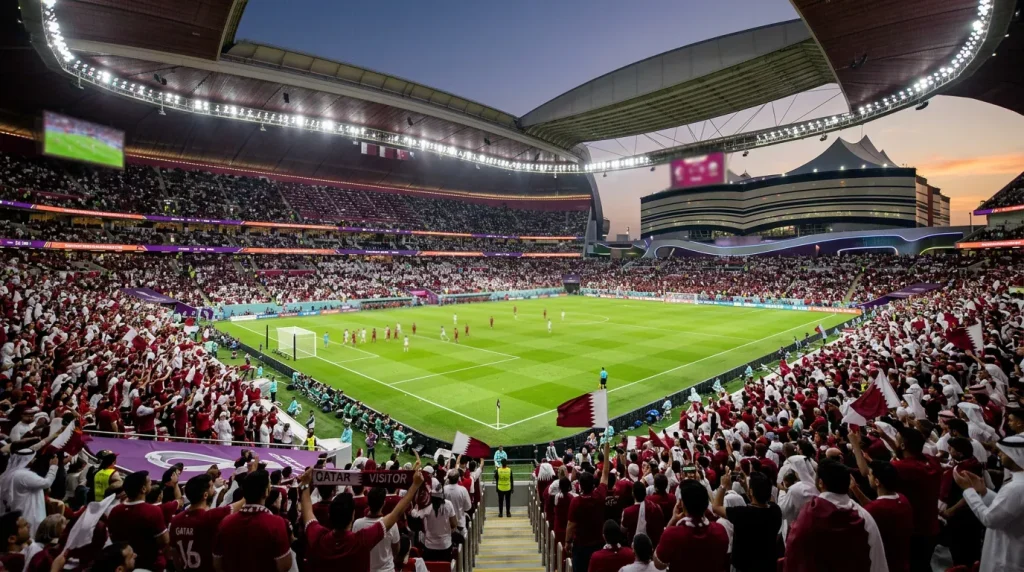
Al Bayt Stadium, November 20th, 2022. I watched Qatar open their home World Cup against Ecuador and lose 2-0 — a defeat that set the tone for a tournament the hosts would rather forget. Three matches, three losses, one goal scored, seven conceded. Qatar became the first host nation to lose all three group-stage matches, a statistical ignominy that overshadowed the tournament infrastructure’s success. The Qatar World Cup 2026 campaign represents an opportunity for redemption, though Group B placement alongside Canada (co-hosts with home advantage), Switzerland (tournament-tested Europeans), and Bosnia and Herzegovina (hungry debutants) provides limited margin for error.
Qatar’s path to 2026 came through AFC qualification rather than automatic hosting berths. The Asian champions (2023 title retained on home soil after their 2019 breakthrough) demonstrated that their domestic program produces competitive regional results even if global quality remains aspirational. For Canadian supporters analyzing Group B, Qatar represents the opponent most likely to yield three points — though the lessons of 2022 suggest that underestimation carries risk. Qatar will arrive in Vancouver on June 18th seeking to prove that their home World Cup failure reflected circumstance rather than fundamental limitation.
Lessons from 2022: Hosting Hangover?
Qatar’s 2022 World Cup campaign deserves examination beyond the scorelines. The team entered having played only regional competition and specifically arranged friendlies for years — the consequence of automatic qualification that removed competitive edge. Their preparation involved training camps and exhibition matches against opponents who knew the fixtures meant nothing. When Ecuador, Senegal, and Netherlands arrived with World Cup intensity, Qatar could not match the competitive sharpness that qualification campaigns provide.
The tactical limitations were evident from the opening whistle. Qatari defenders struggled with the pace and physicality of international-quality attackers. Midfield control — essential against possession-dominant opponents — evaporated when pressed by organized European systems. The attacking structure produced exactly one goal across 270 minutes of football, a header against Senegal that provided Qatar’s sole moment of celebration. The expected goals data was even more damning: Qatar generated approximately 2.1 xG across three matches while conceding 5.8 xG — a differential that suggested fundamental quality gaps rather than unfortunate variance.
The 2026 circumstances differ in meaningful ways. Qatar qualified through AFC competition, playing genuine matches against Japan, Australia, Saudi Arabia, and other regional powers. The competitive edge that 2022 lacked should now exist. The squad has turned over since 2022 — younger players integrated, veterans departed — creating a different composition that may perform differently. The pressure of home hosting no longer applies; Qatar enters as underdogs with nothing to lose, a psychological position that sometimes liberates rather than constrains.
However, structural limitations persist. Qatari football remains domestically focused; the national team draws almost exclusively from Qatar Stars League, where pace and physicality fall below European or South American standards. The few overseas-based players (Akram Afif at Al Sadd remains domestic despite his quality) lack exposure to the competitive intensity that Canada, Switzerland, and Bosnia players experience weekly. This talent pipeline constraint limits Qatar’s ceiling regardless of tactical preparation or motivational factors.
Squad Profile: Asian Champions
Akram Afif represents Qatar’s primary attacking threat and the player most likely to produce moments of individual quality. The 2023 Asian Cup Player of the Tournament confirmed his regional dominance through decisive performances against Japan and Jordan. His technical ability, free-kick quality, and creativity from wide positions give Qatar a focal point around which attacks can build. At 27 during the World Cup, Afif enters his peak years with motivation to demonstrate that Asian excellence can translate to global competition.
Almoez Ali holds the Asian Cup all-time scoring record (12 goals across two tournaments) and provides the finishing that Qatar’s system requires. His movement in the penalty area and aerial ability create chances from crosses and set pieces — delivery-dependent qualities that struggle against organized European defenses but could produce moments against less disciplined opponents. Against Bosnia and Herzegovina, Ali represents Qatar’s most likely goalscorer; against Canada and Switzerland, defensive focus may limit his service.
The midfield has evolved since 2022. Karim Boudiaf provides defensive stability that was lacking in the hosting campaign; his positioning and discipline reduce the chaos that Ecuador and Senegal exploited. Hassan Al-Haydos brings experience from multiple Asian Cups despite advancing age, offering leadership that younger teammates require. The creative dimension beyond Afif remains uncertain — Qatar lacks the playmaking quality that produces chances against set defenses.
Defensively, Qatar’s organization has improved through the post-2022 rebuild. The back line features players with AFC Champions League experience, comfortable against regional opposition but untested against European or CONCACAF quality. Goalkeeper Meshaal Barsham has stabilized the position, though his distribution and command fall below international standards. The defense will need to be organized and disciplined to limit damage against Canada and Switzerland; heroic performances are not realistic expectations.
Group B Chances: Underdog Status
Qatar enters Group B as clear fourth favorites — a positioning that reflects accurate quality assessment rather than disrespect. Switzerland’s tournament experience, Canada’s home advantage, and Bosnia’s motivated debut all provide edges that Qatar cannot match. The mathematical path to qualification requires results that Qatar’s quality level struggles to produce: likely needing four points to have any chance at third-place advancement, requiring either a victory against Bosnia plus draws elsewhere or multiple draws combined with favorable goal difference.
The schedule provides one genuine opportunity. Qatar faces Bosnia and Herzegovina on June 12th in Houston — the opening Group B match for both teams, before Canada plays their opener against Bosnia that same day. If Qatar can secure three points against fellow underdogs, the pressure shifts to subsequent matches. A draw against Bosnia leaves Qatar needing results against Canada and Switzerland that historical patterns suggest are unlikely.
Against Canada on June 18th at BC Place in Vancouver, Qatar enters as significant underdogs. Canadian home advantage (54,000 supporters, familiar conditions, no jet lag) combines with quality differential to produce approximately 70% Canada win probability, 15% draw, 15% Qatar win by most models. Qatar’s best chance involves defensive organization, limiting Canadian chances, and hoping for counterattacking moments through Afif’s creativity. The scenario resembles Costa Rica’s approach against Spain in 2022 (0-7 loss) rather than Saudi Arabia’s against Argentina (2-1 victory).
Against Switzerland on June 24th in Houston, similar dynamics apply. Swiss organization and experience should control the match; Qatar’s path to points requires defensive excellence and clinical finishing that their 2022 campaign did not demonstrate. The fixture matters primarily for determining whether Qatar exits with one point, three points, or none — the difference between respectable participation and repeated humiliation.
Qatar vs Canada: What to Expect
The June 18th fixture at BC Place represents Qatar’s primary obstacle to respectability and Canada’s opportunity to build momentum before the decisive Switzerland match. Both teams understand the stakes: Qatar needs points to salvage a campaign that could otherwise repeat 2022’s embarrassment; Canada needs victory to control Group B destiny heading into the final matchday.
Tactical expectations favor Canadian dominance. Canada’s pace through Davies and Buchanan should exploit Qatar’s defensive transition vulnerabilities. Jonathan David’s movement and finishing quality should generate chances that Qatar’s defense cannot consistently prevent. The crowd advantage — 54,000 supporters creating hostile atmosphere — should add psychological pressure that Qatar experienced negatively in 2022 when their home crowds could not prevent defeats.
Qatar’s approach will likely involve deep defensive positioning, limiting space behind their back line, and seeking counterattacking moments through Afif’s individual quality. If Canada controls 60%+ possession (likely), Qatar must defend effectively for 90 minutes while waiting for occasional opportunities. This approach requires discipline and concentration that Qatar’s 2022 performances did not demonstrate — though different circumstances may produce different outcomes.
My projection: Canada wins 2-0 or 3-1, controlling the match without producing the emphatic scoreline that some expect. Qatar’s organization limits easy chances, but Canadian quality eventually prevails. The margin matters primarily for goal difference rather than standings — Canada and Switzerland will likely qualify regardless of exact results, with Qatar and Bosnia competing for potential third-place consideration.
Qatar Betting Odds
Outright winner odds for Qatar exceed 500.00 at most sportsbooks — essentially novelty pricing that acknowledges mathematical possibility without genuine expectation. No rational bettor considers Qatar championship material; the squad lacks quality to compete beyond group stages even under favorable circumstances.
Group B finishing markets provide the relevant betting context. Qatar to qualify from Group B prices around 7.00-10.00, implying 10%-14% probability. This pricing appears generous given the quality differential against Canada and Switzerland; actual qualification probability sits closer to 5%-8% in my assessment. Qatar would need to defeat Bosnia, draw at least one of Canada/Switzerland, and hope goal difference favors them over Bosnia — a combination of results that requires multiple unlikely outcomes.
Match-specific markets offer clearer opportunities. Qatar to defeat Bosnia prices around 2.80-3.20 — reasonable given opponent quality and neutral venue. Qatar to draw Canada prices around 6.00-8.00 — speculative but not impossible if defensive organization proves superior to 2022 levels. Qatar to defeat Canada exceeds 10.00 — extreme longshot territory where home advantage makes upset probability genuinely minimal.
For Canadian bettors, the Qatar match represents expected value opportunity on Canada victory lines. Canada around 1.40-1.55 to win reflects approximately 65%-70% probability; actual probability may approach 75% given home advantage, quality differential, and Qatar’s tournament history. The value exists in backing Canada rather than seeking Qatar upset — though draw insurance through Asian handicap markets provides risk management for cautious approaches. The Group B analysis provides complete context for Canada’s path through the group stage.
