
Mexico at World Cup 2026: El Tri Host Nation Odds & Analysis
 Available in US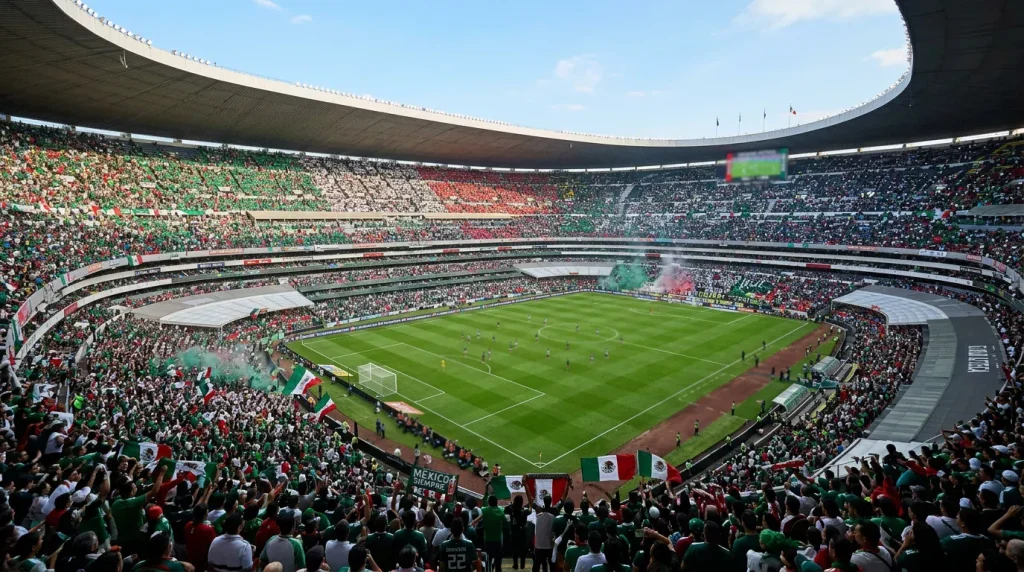
Seven consecutive World Cups. Seven consecutive Round of 16 exits. The pattern haunts Mexican football with a precision that statisticians might admire if it were not so painful. El Tri has qualified for every tournament since 1994, advanced from every group stage, and then fallen in the first knockout round with mechanical consistency. The Mexico World Cup 2026 campaign offers the most significant opportunity to break this curse — co-hosting status, three stadiums including the legendary Estadio Azteca, and home crowds that will transform matches into cultural events. Yet the question persists: can Mexico finally reach a fifth game at a World Cup?
Group A places Mexico alongside South Korea, South Africa, and Czechia. The draw appears favorable for co-hosts seeking group supremacy and momentum heading into knockout rounds. Mexico’s opening match at Estadio Azteca — the tournament’s first fixture, broadcast globally — carries weight beyond mere points. This is Mexico’s statement to the world, the announcement that El Tri intends to compete rather than merely participate. At current odds around 40.00-50.00, Mexico represents a longshot for tournament victory but a legitimate contender for quarter-final advancement if the psychological barriers can be overcome.
Third-Time Hosts: Azteca & Beyond
No stadium in the world has hosted two World Cup finals. Estadio Azteca has hosted two — 1970 (Brazil defeating Italy 4-1) and 1986 (Argentina defeating West Germany 3-2). The Mexico City venue will open World Cup 2026 with Mexico facing South Africa on June 11th, a symmetry that connects three generations of Mexican football history. I remember watching the 1986 final on television, Maradona lifting the trophy in a stadium that seemed to pulse with energy visible through the screen. That energy returns in 2026, amplified by modern atmosphere technology and decades of accumulated passion.
Mexico’s hosting allocation includes three stadiums and 13 matches — fewer than the United States (11 stadiums, 78 matches) but significant nonetheless. Estadio Azteca in Mexico City, Estadio BBVA in Monterrey, and Estadio Akron in Guadalajara provide venues across the country’s football heartland. The altitude factor at Azteca (2,240 metres above sea level) has historically benefited Mexican teams accustomed to thin air that exhausts sea-level opponents. European and South American teams arriving in Mexico City face physiological challenges that home advantage amplifies.
The cultural dimension transcends sport. Football constitutes Mexican national identity in ways that Anglo-American sporting culture cannot fully comprehend. World Cup matches stop the nation — literally, with government offices closing and streets emptying during kickoffs. The 2026 tournament represents Mexico’s opportunity to showcase national pride on the global stage, with implications extending far beyond football results. This pressure — the weight of national expectation combined with historical frustration — shapes every tactical decision and psychological preparation.
Squad Analysis: Transitional Phase
Mexican football finds itself between generations. The golden era featuring Javier Hernández, Andrés Guardado, and Héctor Herrera has concluded — those players either retired from international duty or aged past competitive contribution. The next generation has not yet produced equivalent quality. This transitional reality creates uncertainty that betting markets reflect in Mexico’s extended odds despite home advantage.
Hirving Lozano remains the squad’s most recognizable talent. The Napoli winger won Serie A in 2023 and has demonstrated capacity to perform at European football’s highest levels. His pace and direct running create problems for defenders, though his decision-making in final third situations occasionally frustrates. At 30 during the tournament, Lozano enters his final peak years with motivation to define his international legacy. If Mexico advances beyond the Round of 16, Lozano’s performances will likely be central to that achievement.
The midfield presents tactical questions without clear answers. Edson Álvarez (West Ham) provides defensive stability and leadership, having captained the squad through qualification. His Premier League experience adds credibility that previous Mexican midfielders lacked. However, the creative dimension remains uncertain — who provides the final pass, the moment of inspiration that unlocks organized defenses? This question has plagued Mexican teams throughout the “quinto partido” curse era.
Santiago Giménez’s emergence at Feyenoord addresses the striking void that Chicharito’s decline created. The young forward scored 23 Eredivisie goals in 2024-25, demonstrating clinical finishing that translates across leagues. His movement and aerial ability give Mexico a focal point capable of competing physically with European defenders. The Giménez-Lozano partnership — pace and power, width and central presence — constitutes Mexico’s most dangerous attacking combination heading into the tournament.
Defensively, César Montes and Johan Vásquez provide centre-back options with European experience, though neither has established themselves as elite performers. The goalkeeping situation has clarified with Guillermo Ochoa’s likely retirement from international football, elevating younger options who lack his tournament experience. This defensive uncertainty contributes to skepticism about Mexico’s capacity to navigate knockout rounds against quality attackers.
Group A: South Korea, South Africa, Czechia
South Korea represents Group A’s primary threat to Mexican supremacy. The Taegeuk Warriors reached the Round of 16 in 2022, losing narrowly to Brazil 4-1 after defeating Portugal in the group stage. Son Heung-min remains one of Asia’s greatest players, capable of individual brilliance that decides tight matches. The Korea-Mexico history includes the 2018 World Cup group match (Mexico won 2-1) and numerous friendly encounters. On June 17th at NRG Stadium in Houston, this fixture likely determines Group A’s structure.
South Africa’s return to the World Cup follows their failed 2010 host campaign where they became the first host nation to exit in the group stage. The Bafana Bafana qualified through CAF’s competitive pathway, demonstrating improvement that exceeds their FIFA ranking of 64th. Against Mexico in the opening match at Estadio Azteca, South Africa will face 80,000 hostile supporters at altitude — conditions that could overwhelm even prepared opponents. Three points here establish Mexico’s group stage trajectory.
Czechia qualifies for their first World Cup since 2006, representing a football program in rebuilding mode. The Czech squad lacks the generation that produced Pavel Nedvěd, Tomáš Rosický, and Petr Čech, relying instead on younger talents developing through European leagues. Against Mexico on June 22nd at Estadio Akron in Guadalajara, Czechia represents the weakest group opponent — a match Mexico should control from the opening whistle.
Group A projection: seven to nine points, first place likely if Mexico handles South Korea effectively. The opening match against South Africa should produce three points; the Czechia match similarly. The Korea fixture determines whether Mexico tops the group with nine points or finishes second with six or seven. Bracket implications matter significantly — Group A winners likely face more favorable Round of 32 opponents than runners-up.
Mexico Betting Odds: Breaking the Curse?
Outright winner odds price Mexico between 40.00 and 55.00 at major sportsbooks — typically 12th to 15th favorites. Implied probability sits around 2%-2.5%, reflecting accurate market assessment that Mexico lacks the quality to win seven consecutive matches against progressively elite opposition. The curse is real because the quality gap has been real; home advantage in 2026 provides edges but does not eliminate fundamental limitations.
My assessment places Mexico’s actual championship probability at approximately 1.5%-2.5%, making current odds represent fair value without significant edge. The tournament structure requires defeating elite opponents in quarter-finals, semi-finals, and the final — matches where Mexico has historically struggled regardless of earlier results. Home advantage helps through the Round of 16; beyond that stage, quality determines outcomes more than crowd support.
Group A winner odds around 1.80-2.20 offer the most interesting market for Mexico exposure. El Tri’s probability of topping the group approaches 50% given home advantage, altitude factors, and relative group quality. Odds above 2.00 represent slight positive expected value; odds around 1.80 accurately price the competitive factors involved.
The “quinto partido” market deserves specific attention. Mexico to reach the quarter-finals prices around 3.50-4.50 (22%-29% implied). Given seven consecutive Round of 16 exits, the market appropriately discounts Mexican advancement probability. If you believe home advantage breaks the curse, value exists at higher prices. If you expect the pattern to continue, avoid this market or consider hedging against quarter-final advancement.
Qualification odds around 1.15-1.25 accurately reflect Mexico’s overwhelming likelihood of advancing from Group A. Even a poor tournament would likely yield third place sufficient for advancement under the expanded format. No edge exists here.
The Fifth Game: Will 2026 Be Different?
Since 1994, Mexico has lost Round of 16 matches to Bulgaria (penalties, 1994), Germany (2-1, 1998), USA (2-0, 2002), Argentina (2-1 after extra time, 2006), Argentina (3-1, 2010), Netherlands (2-1, 2014), Brazil (2-0, 2018), and failed to reach the knockout stage entirely in 2022 — their first group-stage exit since 1978. The pattern reveals consistent quality to advance from groups combined with consistent inability to compete with elite opponents in knockout formats.
The 2026 circumstances differ in several respects. Home advantage provides tangible benefits through crowd support, familiar conditions, and reduced travel. The expanded 48-team format means reaching the Round of 32 rather than Round of 16 — a semantic shift that provides an additional knockout match before the traditional barrier point. Mexico’s Round of 32 opponent will likely be weaker than historical Round of 16 opponents, potentially providing the “fifth game” victory that has eluded previous generations.
The psychological dimension remains the unknown variable. Does the squad carry the burden of seven consecutive failures? Or does home advantage provide psychological liberation that allows players to perform without historical weight? The answer likely varies by individual — veterans may feel pressure more acutely than young players unburdened by previous tournament trauma.
Objective assessment suggests Mexico reaches the quarter-finals with approximately 25%-35% probability. The Round of 32 opponent (likely from Group B third place or Group F runners-up) should be manageable. The Round of 16 opponent presents the historical challenge point. If Mexico draws favorably — avoiding Spain, France, England, or Argentina — advancement becomes genuinely possible. If the draw produces elite opposition, the curse likely continues regardless of home advantage.
Tournament Ceiling for El Tri
Mexico’s realistic ceiling sits at the quarter-finals. Reaching the semi-finals would require defeating two of the tournament’s top-eight teams — a feat Mexican football has not accomplished since 1986 when they fell to West Germany in penalties at the quarter-final stage as hosts. The squad quality, tactical sophistication, and psychological resilience required for semi-final advancement exceeds current Mexican capabilities, even with home advantage providing marginal benefits.
The path to quarter-finals requires navigating Round of 32 and Round of 16 matches against opponents that home advantage can influence. If Group A resolves favorably (Mexico first, Korea second), the bracket positions Mexico to face theoretically weaker opposition through two knockout rounds. The quarter-final opponent would then depend on which elite teams advance from other sections — likely Spain, France, or England if bracket positioning aligns.
For Mexican supporters and bettors, the appropriate focus involves quarter-final advancement rather than tournament victory. Breaking the “quinto partido” curse represents the realistic ambition; championship expectations exceed reasonable assessment of squad quality relative to European and South American powers. The home advantage magnifies existing quality rather than transforming mediocrity into excellence.
At 45.00 odds for tournament victory, Mexico offers lottery-ticket appeal without rational justification. At 4.00 odds for quarter-final advancement, genuine value may exist for those who believe home advantage impacts exceed historical patterns. The Group A analysis examines Mexico’s path through the group stage and implications for knockout positioning.
