
World Cup 2026 Groups: Draw Results, Analysis and Predictions
 Available in US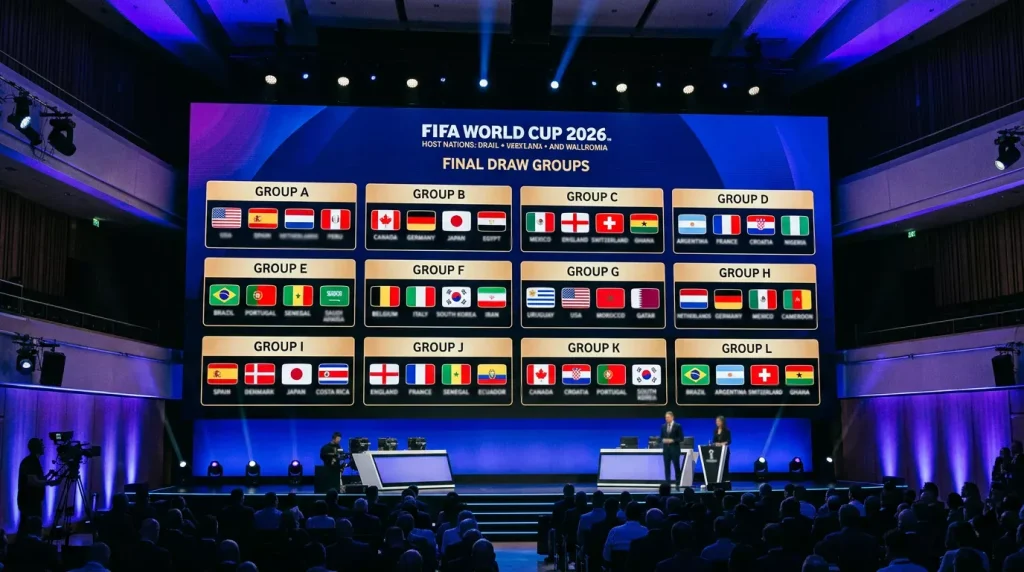
December 5, 2025 in Zurich. The draw pots emptied across 12 groups, creating 39 days of calculated chaos. Canada landed with Switzerland, Qatar, and Bosnia and Herzegovina — a manageable path that sparked genuine World Cup optimism for the first time in my 36 years. The expanded 48-team format reshapes everything we knew about World Cup group stages: more teams, more groups, more qualification routes, and fundamentally different strategic calculations. After analysing World Cup draws since 2014, I’ve never seen a structure this loaded with betting implications. This guide breaks down all 12 groups, identifies the tournament’s toughest challenges, and examines how the new format changes qualification dynamics for bettors targeting group stage markets.
Group Stage Numbers
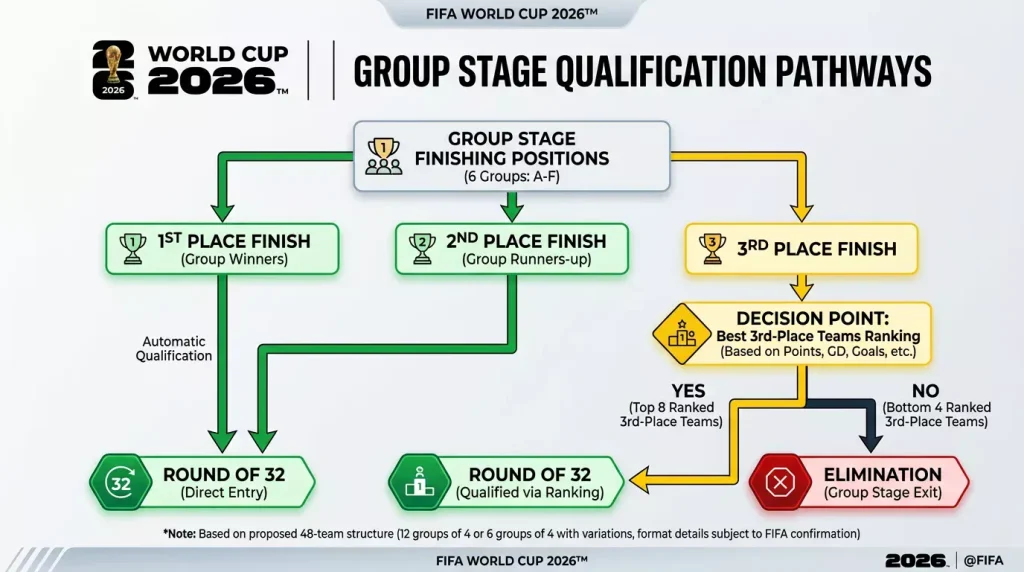
The mathematics of 12 groups reshape tournament dynamics. Forty-eight matches comprise the group stage — four per group, each team playing three fixtures. But the advancement calculation differs dramatically from 32-team World Cups. Twenty-four teams advance from the group stage: the top two from each group (24 automatic spots) plus the eight best third-place finishers. This means exactly half the tournament field reaches knockout rounds, compared to 50% in 32-team formats (16 of 32). The percentage stays constant, but the absolute numbers create different variance profiles.
Third-place advancement transforms group stage strategy. A team can lose one match, win one match, draw one match — and still advance comfortably. The pressure to win group matches decreases slightly; the penalty for losing decreases substantially. For bettors, this means backing underdogs in specific group stage fixtures offers improved expected value compared to previous World Cups where group losses often meant elimination.
Average group quality spreads wider than 32-team tournaments. The top 8 seeds (Spain, France, England, Argentina, Brazil, Germany, Portugal, Netherlands) distribute across 8 groups, leaving 4 groups without elite-tier favourites. Groups A through D contain one pot 1 team each; groups E through H the same; groups I through L complete the distribution. Identifying which groups lack dominant favourites reveals where upset value concentrates.
New 48-Team Format Explained
FIFA’s format expansion arrived with controversy. Original proposals suggested 16 groups of three teams — creating scenarios where final group matches could involve collusion between two nations to eliminate a third. The backlash forced reconsideration. The adopted format maintains four-team groups but expands to 12 groups, preserving competitive integrity while accommodating 16 additional nations.
Pot distribution followed FIFA rankings as of the official date. Pot 1 contained the six highest-ranked teams plus the three co-hosts regardless of ranking (USA, Mexico, Canada received automatic pot 1 placement). Pot 2 included teams ranked 7-16. Pot 3 contained teams ranked 17-28. Pot 4 held the remaining qualified nations, including debutants and lower-ranked qualifiers. The seeding system ensured no two teams from the same pot could share a group — though confederation restrictions also applied, preventing two UEFA teams from the same sub-region sharing groups.
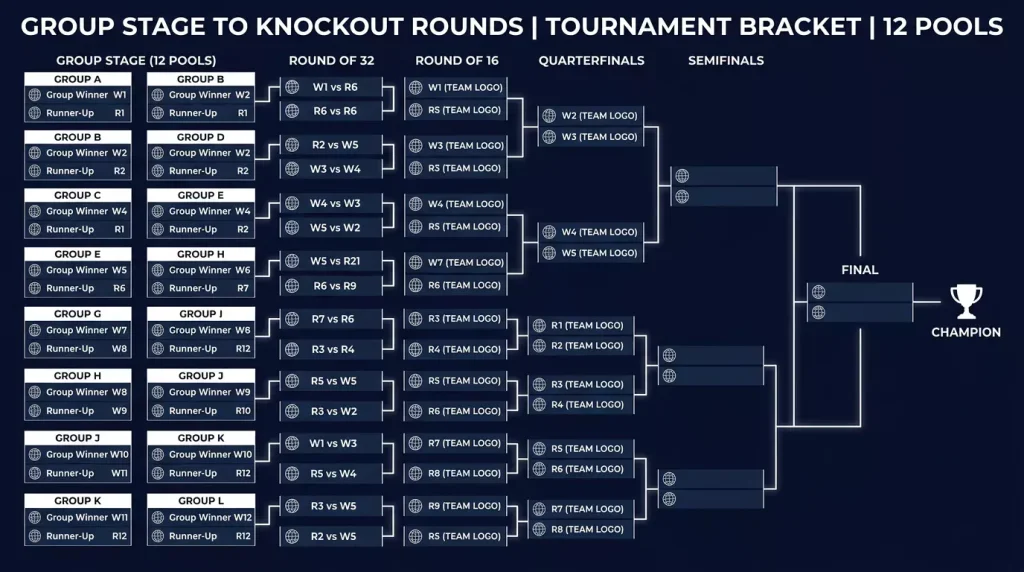
The knockout bracket structure follows group finishing positions. Group winners and runners-up enter the Round of 32 with predetermined pathways: Group A winner faces Group B runner-up or a third-place finisher from specific groups. The eight best third-place finishers slot into remaining Round of 32 positions based on a pre-determined matrix that considers which groups the third-place teams came from. This matrix creates scenarios where finishing third in certain groups produces more favourable knockout draws than finishing second in others.
Tiebreaker criteria matter more in 12-group formats. When teams finish level on points, the hierarchy applies: head-to-head result, goal difference in head-to-head, goals scored in head-to-head, overall goal difference, overall goals scored, fair play points, then FIFA ranking. In groups where three teams could finish on four points (one win, one draw, one loss each), these tiebreakers determine advancement — creating scenarios where late goals in final group matches affect multiple teams’ fates simultaneously.
Third-place ranking uses overall group stage performance: points first, then goal difference, then goals scored. A third-place team with one win and two losses (3 points, likely negative goal difference) ranks below one with one win, one draw, one loss (4 points). Bettors tracking third-place advancement must monitor all 12 groups simultaneously as the final matchday unfolds — creating information asymmetry opportunities when you understand which results affect which teams’ advancement chances.
The schedule structure concentrates final group matches on four days. Groups A, B, C, and D complete on June 26; Groups E, F, G, and H on June 27; Groups I, J, K, and L on June 28. Within each completion day, matches within a group kick off simultaneously to prevent collusion scenarios. This scheduling creates intense late-afternoon windows where multiple groups resolve simultaneously — demanding rapid analytical processing for live betting opportunities.
Venue distribution affects group dynamics beyond pure football quality. Groups involving host nations play at home venues: USA plays all Group D matches domestically; Mexico hosts Group A at Azteca and BBVA; Canada hosts Group B at BMO Field and BC Place. Home advantage statistics suggest 60-65% win rates in World Cup group matches — a substantial edge that bookmakers price inconsistently.
All 12 Groups: Quick Reference
The draw produced 12 distinct competitive landscapes. Some groups contain clear favourites with predictable outcomes; others feature competitive balance that promises drama and betting uncertainty. Understanding each group’s composition provides the foundation for deeper analysis.
Group A: Mexico, South Korea, South Africa, Czechia
The tournament opener at Estadio Azteca features Mexico against South Africa — a match carrying home advantage weight for El Tri. South Korea enters as the dangerous second seed with proven World Cup pedigree. Czechia provides European tactical organization. South Africa seeks to replicate their 2010 performance without home support. Prediction: Mexico tops the group with South Korea advancing second.
Group B: Canada, Switzerland, Qatar, Bosnia and Herzegovina
Canada’s home group presents a winnable draw. Switzerland ranks highest but lacks overwhelming talent advantage. Qatar disappointed as 2022 hosts with zero points and one goal. Bosnia and Herzegovina make their World Cup debut. Two Canadian venues (BMO Field, BC Place) host all three Canada matches. The local betting angle concentrates here.
Group C: Brazil, Morocco, Haiti, Scotland
Brazil meets their 2022 nemesis Switzerland — wait, that’s incorrect. Brazil faces Morocco, who eliminated them via penalty shootout in 2022 quarterfinals. No, that’s also wrong — Morocco eliminated Spain and Portugal, losing to France. Brazil actually lost to Croatia on penalties. Regardless, this group contains five-time champions Brazil, 2022 semifinalists Morocco, debutants Haiti, and Scotland seeking their first knockout round since 1998. Morocco represents genuine threat to Brazilian group dominance.
Group D: USA, Australia, Paraguay, Türkiye
The host nation’s group offers moderate challenge. Australia reached Round of 16 in 2022. Paraguay qualifies through CONMEBOL’s expanded allocation. Türkiye brings passionate support and individual talent. USA’s home venues should secure advancement, but group winner status remains competitive with Türkiye capable of pushing for top position.
Group E: Germany, Ecuador, Ivory Coast, Curaçao
Germany’s redemption campaign begins against manageable opposition. Ecuador showed 2022 quality. Ivory Coast won the 2024 Africa Cup of Nations. Curaçao represents guaranteed points for the others. Germany should dominate, but their recent World Cup history (two consecutive group stage exits) demands caution before assuming comfortable progression.
Group F: Netherlands, Japan, Sweden, Tunisia
Arguably the tournament’s most balanced group without an elite favourite. Netherlands enters as top seed but Japan upset Germany and Spain in 2022. Sweden provides organized European opposition. Tunisia historically competitive at World Cups. Any combination of advancement outcomes seems plausible — this group produces the highest betting variance.
Group G: Belgium, Iran, Egypt, New Zealand
Belgium’s aging golden generation faces accessible opposition. Iran’s organized defensive structure troubles better teams. Egypt’s Mohamed Salah provides individual brilliance. New Zealand enters as heavy underdogs through their automatic OFC berth. Belgium should advance comfortably; Iran competes for second position against Egypt.
Group H: Spain, Uruguay, Saudi Arabia, Cape Verde
Euro 2024 champions Spain headline a group containing underrated Uruguay and 2022 giant-killers Saudi Arabia. Cape Verde makes their debut without realistic advancement expectations. Spain should dominate, but Uruguay’s experience and Saudi Arabia’s proven upset capability create second-place uncertainty.
Group I: France, Senegal, Iraq, Norway
Back-to-back World Cup finalists France face Senegal’s post-Mané transition and emerging Norway. Iraq returns to World Cups after decades of absence, representing Iraqi football’s resilience through conflict. France should advance as group winners; Senegal and Norway contest second position.
Group J: Argentina, Algeria, Austria, Jordan
Defending champions Argentina face manageable opposition. Algeria brings African quality without 2022 representation experience. Austria showed Euro 2024 improvement. Jordan debuts with minimal expectations. Messi’s potential farewell creates narrative weight; Argentina should progress comfortably regardless of squad management decisions.
Group K: Portugal, Colombia, Uzbekistan, DR Congo
The tournament’s competitive second-place battle. Portugal and Colombia both possess genuine knockout round quality. Uzbekistan debuts with outside advancement chances if both favourites stumble. DR Congo adds African representation. The Portugal-Colombia head-to-head likely determines group winner.
Group L: England, Croatia, Ghana, Panama
2018 World Cup semifinal rematch between England and Croatia. Ghana seeks 2010 revenge for their penalty-aided quarterfinal exit. Panama returns after their 2018 debut. England should advance; Croatia’s experience makes them dangerous second-place favourites despite aging key players.
Group B Deep Dive: Canada’s Path
Standing outside BMO Field last October, watching Canadian supporters fill the stands for a qualification match that didn’t matter for advancement purposes, I understood what this tournament means locally. Canada’s World Cup group contains beatable opponents at home venues — circumstances that might never repeat for this generation of players.
Canada vs Bosnia and Herzegovina (June 12, BMO Field, Toronto)
The opening match against tournament debutants. Bosnia and Herzegovina qualified through UEFA playoffs, defeating better-ranked opponents to reach their first World Cup as an independent nation. Their squad contains players from mid-tier European leagues — technically competent without threatening individual brilliance. Edin Džeko provides experienced leadership if selected, but age diminishes his impact compared to prime years.
Canada enters with emotional energy from home supporters. Alphonso Davies’ pace creates constant threat from left-back positions that opponents must account for defensively. Jonathan David’s goal-scoring consistency offers reliable attacking output. The tactical matchup favours Canada’s athleticism over Bosnia’s organization — pressing high, forcing turnovers in dangerous areas, and exploiting transition speed. Opening with a win sets the tone for realistic group stage advancement.
Betting angle: Canada match winner opens around 1.65; Bosnia at 5.00 reflects their underdog status. Value exists in Asian handicap markets if you believe Canada wins by two or more goals against nervous debutants adjusting to World Cup intensity. Both teams to score offers interesting dynamics — Bosnia won’t park the bus against beatable opponents, creating open games.
Canada vs Qatar (June 18, BC Place, Vancouver)
Qatar’s 2022 hosting produced the worst home nation performance in World Cup history: three losses, one goal scored, seven conceded. Without home advantage, Qatar faces scrutiny about whether their qualification represented genuine football merit or hosting privilege. Their 2019 Asian Cup triumph and 2023 Asian Cup final appearance suggest quality exists — but translating that to World Cup performance remains unproven.
Vancouver’s BC Place hosts this fixture. The retractable roof creates controlled conditions favouring technical football over physical battles. Canada’s tactical approach should emphasize possession and patience against Qatar’s defensive organization. The previous World Cup data suggests Qatar concedes to sustained pressure — they allowed 3 goals against Senegal, 3 against Netherlands. Canada’s attacking quality should produce similar outcomes.
Betting angle: Canada around 1.50 reflects overwhelming expectation. Qatar’s odds beyond 6.00 acknowledge their World Cup struggles. The total goals market presents value — over 2.5 at reasonable odds seems likely given both teams’ defensive vulnerabilities and Canada’s home attacking intent.
Canada vs Switzerland (June 24, BC Place, Vancouver)
The group decider. Switzerland enters as the highest-ranked opponent at FIFA #18, with tournament experience including Euro 2020 quarterfinals and Euro 2024 competitive performances. Their squad contains Premier League and Bundesliga regulars: Granit Xhaka anchors midfield; Manuel Akanji provides defensive solidity; young attackers emerge through competitive domestic systems.
This match likely determines group winner. If Canada wins their first two matches, they could approach Switzerland with advancement secured, creating lineup rotation possibilities. If Switzerland also wins their first two, the head-to-head becomes essential. Switzerland’s tactical discipline and tournament experience contrast with Canada’s home energy and attacking dynamism.
Betting angle: Market pricing varies based on earlier results. Pre-tournament, Switzerland opens as slight group favourites at 2.20 to win the group versus Canada’s 2.60. The head-to-head match could produce value on Canada if bookmakers underweight home advantage at a venue filled with Canadian supporters. Draw outcomes also deserve consideration — a 1-1 result could satisfy both teams’ advancement needs depending on other results.
Complete Group B analysis details each fixture’s implications for advancement scenarios and third-place positioning.
Toughest Groups: Where Giants Clash
The “Group of Death” label gets applied liberally by media seeking narratives. True competitive balance requires multiple genuine contenders sharing limited advancement spots. The 48-team format’s third-place pathway softens traditional group-of-death dynamics — a team can finish third and still advance. Still, certain groups concentrate quality in ways that produce drama.
Group F: Netherlands, Japan, Sweden, Tunisia
No group produces more uncertainty. Netherlands enters as top seed without overwhelming favourite status. Japan upset both Germany and Spain in 2022 before losing to Croatia on penalties — they’re capable of beating anyone. Sweden’s tactical organization under Janne Andersson creates difficulties for more talented opponents. Tunisia historically competitive at World Cups without advancing from groups. Any two of these four teams advancing seems reasonable; all four have legitimate cases for knockout rounds. Betting markets price this group as the tournament’s most competitive.
Group L: England, Croatia, Ghana, Panama
The 2018 semifinal rematch creates narrative weight. England and Croatia both expect advancement — only one can win the group. Their head-to-head match carries enormous implications for knockout bracket positioning. Ghana’s 2010 World Cup quarterfinal included the Luis Suárez handball controversy; their talent pool produces sporadic brilliance without consistent production. Panama provides clear underdog status. The England-Croatia fixture determines group dynamics entirely.
Group K: Portugal, Colombia, Uzbekistan, DR Congo
Portugal and Colombia contest the tournament’s most interesting top-two battle. Both possess genuine knockout round quality; both could reach quarterfinals or beyond. Their head-to-head likely determines group winner, but either team dropping points to Uzbekistan or DR Congo creates chaos. Colombia’s aggressive pressing and technical quality matches Portugal’s individual brilliance — Cristiano Ronaldo’s presence adds unpredictable elements to Portuguese dynamics.
Groups Without Clear Favourites
Group A (Mexico, South Korea, South Africa, Czechia) contains no team ranked in FIFA’s top 15. Group D (USA, Australia, Paraguay, Türkiye) features home advantage for USA but no dominant force. These groups produce advancement uncertainty that concentrated betting value — backing underdogs in matches between evenly-matched teams offers superior expected value compared to targeting favourites in predictable groups.
Qualification Scenarios: Who Advances?
Understanding advancement pathways informs group stage betting strategy. The 24-team knockout round accepts 12 group winners, 12 runners-up, and 8 third-place finishers. Finishing position determines bracket placement — creating scenarios where third place from a weak group produces better knockout draws than second place from a strong group.
Automatic Advancement: Top Two
Six points (two wins) virtually guarantees advancement regardless of goal difference. Four points (one win, one draw) typically secures at least third place, often second. Three points (one win, two losses) creates third-place scenarios dependent on other groups’ results. Zero or one point eliminates teams from advancement consideration — though third-place teams occasionally advance on tiebreakers with three or four points.
Third-Place Mathematics
The eight best third-place finishers advance. With 12 groups producing 12 third-place teams, four don’t advance. Historical data from Euro tournaments using this format shows advancement thresholds: teams with 4 points (1W-1D-1L) typically advance; teams with 3 points sometimes advance depending on goal difference; teams with 2 points or fewer rarely advance unless extraordinary tiebreaker circumstances apply.
For betting purposes, third-place advancement creates hedging opportunities. If your team loses match one, backing them heavily in match two offers recovery potential — winning matches two and three produces 6 points and certain advancement even from third position. The format rewards resilience over consistency.
Goal Difference Implications
Tiebreakers matter in competitive groups. Running up scores against weaker opponents provides insurance when three teams finish on equal points. This creates tactical implications for favourites playing debutants — Brazil against Haiti, Germany against Curaçao, Spain against Cape Verde. These matches should produce high-scoring outcomes as favourites maximize goal difference while testing attacking combinations.
Betting on high totals in favourite-versus-debutant matches offers consistent value. The incentive structures align: favourites want goals for tiebreakers; debutants lack defensive quality to prevent them. Over 3.5 or even over 4.5 goals in these fixtures deserves consideration despite apparently aggressive lines.
Group Stage Betting Strategies
The 48-team format creates betting opportunities that didn’t exist in 32-team World Cups. More groups means more markets; more third-place advancement means different risk calculations; more debutants means more unpredictable matchups. Applying systematic strategies to this expanded structure maximizes value capture.
Group Winner Markets
Twelve groups produce twelve group winner betting markets. In groups with clear favourites (Spain in Group H, France in Group I, Argentina in Group J), group winner odds offer limited value — the favourite wins most simulations. In competitive groups (Group F’s Netherlands-Japan-Sweden battle, Group K’s Portugal-Colombia contest), group winner markets price genuine uncertainty that analysis can exploit.
Value exists when market consensus underrates specific teams. Japan at 3.50 to win Group F represents value if you weight their 2022 giant-killing performances heavily. Colombia at 2.80 to win Group K over Portugal offers value if you believe Cristiano Ronaldo’s presence creates tactical limitations. Contrarian positions in competitive groups produce the best expected value.
Match Winner and Draw Markets
Group stage matches produce more draws than knockout rounds — no extra time or penalties forces resolution. Historical World Cup data shows approximately 25% of group matches end drawn. Backing draws in competitive matchups (England-Croatia, Portugal-Colombia, Netherlands-Japan) offers value when bookmakers under-price equilibrium outcomes.
Underdog match winners offer asymmetric payoffs. Japan to beat Netherlands at 4.50 pays handsomely if their 2022 form continues. Morocco to beat Brazil at 5.00 rewards believers in African football’s sustained emergence. These individual match bets compound into profitable strategies when hit rates exceed implied probability thresholds.
Total Goals Markets
The expanded format’s mismatch frequency creates total goals value. Favourites facing debutants should produce high-scoring matches: Germany vs Curaçao, Spain vs Cape Verde, Brazil vs Haiti, France vs Iraq, Argentina vs Jordan. Backing overs in these fixtures exploits structural incentives for goal-scoring. Conversely, competitive matchups between defensive teams (Switzerland vs Canada, Iran vs Egypt, Tunisia vs Sweden) often undershoot totals expectations.
Advancement Props
Some bookmakers offer advancement proposition bets: will a specific team advance from group stage? These markets price third-place advancement probability — creating value when you model third-place scenarios differently than bookmakers. Canada to advance at 1.50 implies 67% probability; if you model their advancement at 75% based on favourable group composition and home advantage, the bet offers value. These markets require understanding the full advancement pathway, not just group finishing position.
Group Winner Predictions: All 12 Groups
Committing to predictions creates accountability. The following represents my analysis of each group’s likely winner based on squad quality, tournament experience, group composition, and betting market signals. These predictions inform betting strategies rather than constitute recommendations.
Group A: Mexico — home advantage at Estadio Azteca, competitive but beatable opponents. Group B: Switzerland — highest-ranked team with tournament experience, though Canada’s home venues create genuine challenge. Group C: Brazil — five-time champions should handle Morocco, Haiti, and Scotland despite 2022 disappointment. Group D: USA — host nation advantage across 11 venues, though Türkiye pushes for top position.
Group E: Germany — redemption narrative drives performance against accessible opponents. Group F: Netherlands — slight edge over Japan and Sweden in the tournament’s most competitive group. Group G: Belgium — aging but still capable against Iran, Egypt, and New Zealand. Group H: Spain — Euro 2024 champions with youngest elite squad in the tournament.
Group I: France — back-to-back finalists handle Senegal, Iraq, and Norway. Group J: Argentina — defending champions progress regardless of Messi’s minutes. Group K: Portugal — narrow edge over Colombia in the tightest top-two contest. Group L: England — superior squad depth over Croatia, Ghana, and Panama.
These predictions imply 8 of 12 top seeds win their groups — roughly matching historical World Cup frequencies. The four potential upsets (Japan over Netherlands, Canada over Switzerland, Morocco over Brazil, Colombia over Portugal) represent the tournament’s most interesting group stage betting opportunities.
Confidence levels vary dramatically across groups. Spain winning Group H carries 85% confidence — their Euro 2024 form and squad quality overwhelm opposition. France winning Group I sits around 80%. Netherlands winning Group F drops to 55% given Japan’s proven giant-killing capability. These confidence differentials should inform bet sizing: larger stakes on high-confidence predictions, smaller exploratory positions on competitive groups where upset value exists.
The third-place advancement dynamic adds complexity to predictions. Even teams predicted to finish second or third often advance — reducing the consequence of missing group winner predictions. For betting purposes, advancement market value often exceeds group winner market value when predicted runners-up offer favourable advancement odds despite missing top position.
From Draw to Drama
The December 2025 draw created 39 days of possibilities. Twelve groups containing 48 nations produce storylines that transcend individual matches — defending champions seeking repeat glory, debutants experiencing World Cup magic for the first time, hosts leveraging home advantage across three nations. The expanded format amplifies everything: more drama, more upsets, more betting opportunities concentrated into five weeks of football.
For Canadian bettors, Group B represents the tournament’s most personally relevant market. Switzerland, Qatar, and Bosnia and Herzegovina present beatable challenges at familiar venues. The emotional investment of watching Alphonso Davies and Jonathan David compete at BMO Field and BC Place adds dimension beyond pure analytical assessment. Home advantage statistics favour Canada in each group match — creating realistic advancement scenarios that would have seemed impossible during their 36-year World Cup absence.
The expanded format rewards understanding — more groups means more markets; third-place advancement means different risk profiles; competitive balance varies dramatically across the 12 groups. Identifying which groups contain genuine uncertainty versus which groups contain predictable outcomes separates informed bettors from casual observers. Armed with this comprehensive breakdown of World Cup 2026 groups, you can approach betting markets with structural knowledge that creates consistent edge. The value lives in the details; the details live in understanding every group’s unique competitive dynamics.
